

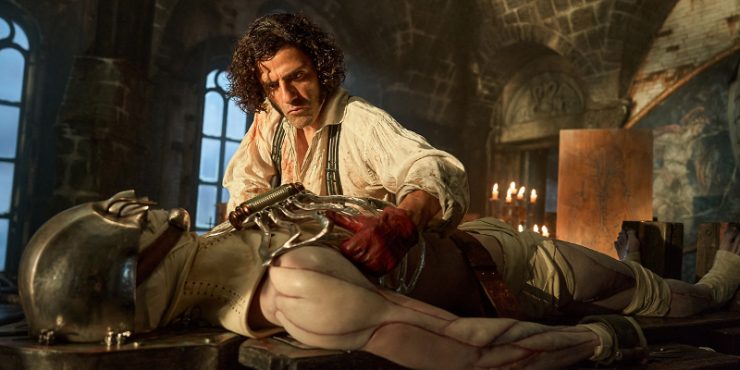
Guillermo Del Toro’s transition from superlative genre master to awards season mainstay happened – for the most part – without Del Toro sacrificing the seedier elements of his creature feature obsessions. Still, it’s hard not to see that Del Toro has sacrificed a little bit of his edge in the name of taste. He still includes a large helping of the grotesque, but the sincere aspects of his screenplays are starting to encroach a bit. Now, he’s doing Frankenstein, a faithful adaptation of the Mary Shelley novel, three years after doing a take on Pinocchio which layered in mid-century fascism. Before that, he made Nightmare Alley, a prestige remake of a 40s noir classic. Why such a preoccupation with redoing others’ material? Especially when doing so in such a studious manner appears to betray the genre roots of the source material?
“Man is society’s true monster” is a major theme throughout all of Del Toro’s most famous work. So on the one hand, it would appear that Frankenstein is the perfect “passion project” for the Oscar-winning filmmaker, but on the other hand it feels unmistakably obvious. What is there in a take on Shelley’s beloved gothic classic that would separate it from the themes of The Shape of Water? Shape of Water being his Oscar winner is a curio of awards season history, even if it does fit perfectly within Del Toro’s macabre sentimentality. Say what you will about that film’s quality or staying power (winning Best Picture over the likes of Lady Bird, Get Out, Dunkirk, and Phantom Thread can never be explained), that was an original idea flush with all the eccentricities that make Del Toro such a charming storyteller. It did not feel the need to be propped up by prestigious source material like every film he’s made since.
Del Toro’s script follows Shelley’s book pretty closely, foregoing the grunting stiff that Boris Korloff played in the iconic 1931 horror classic. This version seeks to capture the romantic elegance of the novel which includes a much more eloquent monster. The monster – or “the creature” – is played here by Jacob Elordi, the incredibly tall Euphoria actor. Elordi electing to go against his stunning good looks to play a grotesque is not a new phenomenon, but his performance here is the film’s highlight. Elordi captures not only the fearsomeness of the creature, but also the childlike vulnerability, which has always been this story’s main source of compelling drama. But in sticking so strictly to the source material, the first half of Frankenstein is about the doctor himself, Victor Frankenstein, played by Oscar Isaac.
Isaac, usually one of the more dependable actors you could ever have, feels very much at sea here. Woefully miscast, Isaac’s entire performance is over-compensation, a one-man melodrama played to the rafters. Not a crime in and of itself, but as you spend the first 80 minutes of the movie waiting for Elordi’s creature to return (you get a brief, exciting glimpse of him in the movie’s prologue/framing device), one really struggles to hang with the neurotic, solipsistic Victor as he goes on his mad journey to conquer death. He gets assistance from a sinister benefactor played by Christoph Waltz, but Victor is more interested in the investor’s daughter, Elizabeth (Mia Goth), who ends up engaged to Victor’s brother, William (Felix Kammerer). It’s a not quite love triangle that’s a not quite dramatic complication, a further bloating that only prolongs the wait for what you’re really here to see: Elordi’s creature.
Once we get to the second half (“The Creature’s Story”), action picks up considerably and so does the film, even if it does feel a tad a little too late. A sequence where the creature befriends a kindly blind man (David Bradley) who teaches him to speak and to read is sufficiently poignant. The creature’s main yearning is to be the very human that Victor was trying to create, but Victor proves to be a cruel parent, mirroring the emotional and physical abuse of his own father (played in flashbacks by Charles Dance – another detail that’s criminally on the nose!). People fear the creature’s barbarity while refusing to see his humanity. The tragic irony is that the creature must then use that barbarity in order for his humanity to even be recognized. It’s perfect structure and it’s why Frankenstein has endured as a story for so long.
But Del Toro’s script is too one-note. His Victor is a human who is a complete monster, and his monster is always achingly human. One questions why have such strong narrative fidelity to Shelley’s book while so flagrantly misinterpreting the book’s exquisite complexity? It’s obvious that Del Toro has cherry picked the meaning that he wanted this story to have, which is his wont. But going through the trouble of making this grand production only to tell the same story – “Man is society’s true monster” – feels like a waste of effort. And there is great effort within Kate Hawley’s beautiful costumes, Dan Lausten’s painterly cinematography, and Tamara Deverell’s gorgeous production design. It’s all quite stunning to behold. But does Del Toro have anything to say? Nothing that he hasn’t already said before to much better effect.
Perhaps the once purveyor of brilliant genre schlock has left us. A similar affliction has hit Kathryn Bigelow, another talented filmmaker who has become substantially less interesting since winning an Academy Award. The main difference is that Del Toro is still routinely let into the Oscar fold – it’s been a decade since a film of his wasn’t nominated for something. Perhaps that adds a pressure to be a “serious filmmaker”, which can plague someone as populist-minded as he is. His reputation as a stylist can’t be argued, but his vision as a storyteller feels not simply stunted, but lacking. You cannot resurrect the works of other giants in hopes of supplanting your own stasis, but Del Toro continues on. In this way, he proves to be much closer to Victor than his beloved creature.
.
Written for the Screen and Directed by Guillermo Del Toro