



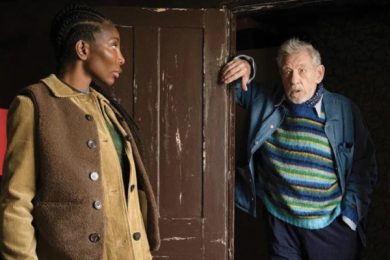





In his last three films, German director Edward Berger has established himself as a superlative stylist. All Quiet on the Western Front was a deadly serious literary adaptation that announced Berger to the world because it displayed his skill on scale. Then there was Conclave last year which, against the odds, became the most meme-d Oscar contender of 2024. If All Quiet was based on a classic, Conclave was based on schlocky airport fiction, but Berger and screenwriter Peter Straughan understood how to make it compelling, cinematic drama. Add a veteran cast led by Ralph Fiennes and you have one of the big populist hits of last year’s awards season. Berger’s latest, Ballad of a Small Player, is another book adaptation. This time it’s a novel from Lawrence Osborne, a British journalist. The movie’s story – a struggling gambler struggles for his soul – is pretty common stuff. It’s Berger’s gorgeous rendering that makes the movie worthwhile.
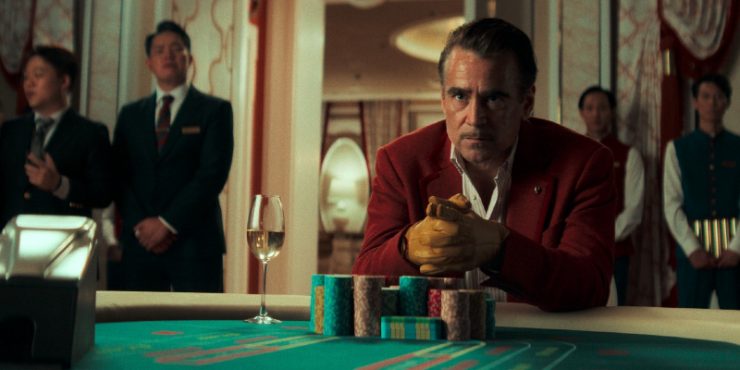
Ballad of a Small Player takes place in China, mostly in the gambling hub of Macau, a lush, colorful locale that is the home of numerous white expatriates with spurious reputations. One of them is Lord Doyle (Colin Farrell), a compulsive gambling addict who is hiding out from financial crimes he committed in the UK. Doyle is an Irishman, but he speaks with an upscale British accent, a further gilding of the lily in his charade to disguise his true nature. Bad luck has followed him East where he owes his local casino hundreds of thousands of dollars. On top of that, he’s been tracked down by investigator Cynthia Blithe (Tilda Swinton), who has specific instructions to recover what Doyle owes in Britain or deport him back to the country where he’s a wanted criminal. One of the few friendly faces Doyle encounters is Dao-Ming (Fala Chen), a beautiful but mysterious loan shark who offers to fund Doyle’s unlikely comeback, but at a high price.
Like all great stories about gambling, we learn that all the players, big and small, are underwater in some way or another, and that the demand for winning – the chronic need to play the odds – is fueled by debts unpaid elsewhere. Small Player‘s script is by Rowan Joffé, and it treats the gambling scenes with appropriate moxie. Sure, the film runs out of steam whenever we step out of the casinos, but Berger knows where to put the energy. The Macau location allows the director, with cinematographer James Friend, to develop an absolutely luscious color palette, that splashes off the remarkable costumes produced from Lisy Christl. This is simply a wonderful film to look at. (Volker Bertelmann’s score ensures that it’s an excellent movie to listen to as well.) Even as it appears to depict Macau as a moral-less purgatory for wayward whites, Berger still gets the setting to pop wondrously throughout the film. I’m sure for many, that is part of the film’s problem.
And the movie surely has it’s problems. It’s subtle themes of Eastern mysticism seem well-fit to a novel, but its rendering on film is not not orientalist in its execution. The enigmatic Dao-Ming and a ruthless, elderly gambler only ever described as “Grandma” (Deanie Ip, in an admittedly strong performance), are the only Chinese characters given anything real to play, but it’s never independent from Doyle’s soul-searching recriminations. By the film’s end, Doyle’s eventual rehabilitation seems pat. It also falls into the trap of many a gambling movie: the very vice that has so insidiously put him in this position is the only means of escape; ie, gambling is good, actually, when you win. That’s perhaps too simplistic a reading, but Berger and Joffé don’t invest enough in the story for you to realistically take it any other way. I quite enjoyed this film in its construction, if not its themes, and it makes one hopeful that when Berger gets another script that is worthy (like Conclave), the machinations will come together again to make something truly great.
.
Directed by Edward Berger