







Ira Sachs’s latest film, Peter Hujar’s Day, is pretty transparent about its intentions. The movie is more art experiment than narrative feature. The totality of what we watch is based on a portion of an abandoned art project by writer Linda Rosenkrantz, who wished to capture the granular, day-to-day details of her New York City artist friends. Linda recorded conversations in the Fall of 1974, including one with photographer Peter Hujar. The tape is gone but a transcript exists, and this transcript is the basis for Sachs’s screenplay, which takes the alluring, occasionally whimsical words of Hujar and stretches them for an entire movie. Peter is played by Ben Whishaw and Linda is played by Rebecca Hall, too very good British actors who play bohemian Americans here. Beyond capturing the quotidian aspects of Peter’s life, Peter Hujar’s Day also immaculately recreates a New York City that was much more hospitable to an artist with very little money.
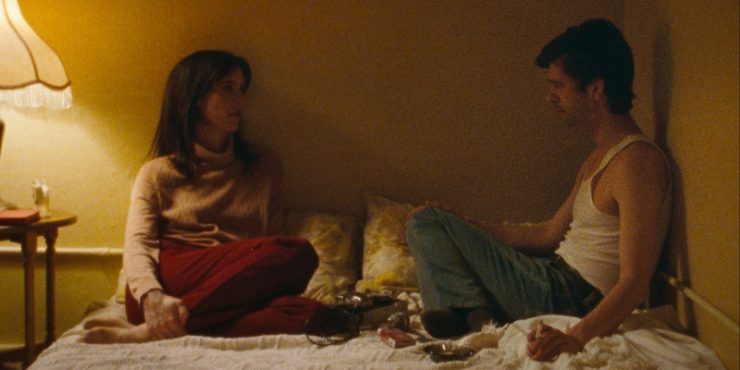
At the beginning of their conversation, Peter speaks in great specifics, but as he continues, his observations expand into more existential territory, and opinions find their way in. He speaks about the vanity of fellow NYC iconoclasts like Allen Ginsberg and Susan Sontag, detailing the ways he assuages their egos. He explains the inherent complications that come with getting paid as a freelance artist, confessing a willingness to go unpaid as a younger artist, so afraid he was of the awkwardness of requesting compensation. Sachs moves the conversation throughout the trendy Greenwich Village apartment. Sometimes they speak at a dining table, sometimes they’re splayed across his bed, occasionally they’re standing on his building’s roof overseeing the city. The conversation moving in one fluid motion regardless of the location. Outfit changes occur without explanation. As Peter continues to describe his life, Sachs gives us a visual display that both confirms and contradicts the things he tells Linda.
The effect is surprisingly majestic. The sparseness of the film’s setting is not seen as a limitation for Sachs. His incredible curiosity with Peter’s loquaciousness inspires him to time travel into a Manhattan that seems almost utopian, even as Peter explains the various levels of his financial hardship. But Peter has the benefit of an artistic community, represented beautifully by Linda’s willingness to listen so long and so attentively. Whishaw’s portrayal is wonderfully naturalistic but actively compelling, complimenting Sachs’s visual flair and adding to the movie’s hypnotic quality. Hall doesn’t speak nearly as much but her presence is a perfect example of a generous scene partner, frequently setting up Whishaw for hilarious and sobering observations. “Acting is reacting”; Hall embodies that edict perfectly. It’d be easy for this to feel like an acting exercise, but the two veterans show real interest in their subjects and flesh them out into real human beings.
It’s astonishing, really, how Sachs manages to make Peter Hujar’s Day a transporting experience. He leans on the charisma of Whishaw and the precision of Hall, but he also frames their performances beautifully with cinematographer Alex Ashe, giving the conversation the gritty quality of an analog era. The film is romantic without being sentimental, and is profound in its display of the ordinary. Its recreation of 1970s New York – a time and place so frequently conjured in movies these last few decades – feels very much of its own, allowing proper esteem while paying proper credence to the emotional and financial hardships many New Yorkers felt at the time, especially those in oppressed communities. There’s not too much drama made of Peter’s homosexuality, and that’s not really the point of the film anyway. It’s a portrait of an artist that dares to say that creative people – even particularly talented ones – are still fated to the indignities, humiliations, and crises of the common man. But in examining it in the way he and Linda do here, they find that even the ordinary can reveal something much more fascinating.
.
Written for the Screen and Directed by Ira Sachs