







Even within the rich history of Iranian cinema, Jafar Panahi’s films stand out. His movies are often defined by the limitations of the production. As many filmgoers already know, the Iranian government imprisoned Panahi in 2010 for crafting stories that failed to amplify the regime. Part of that sentence was a twenty-year ban on making films of any kind. Panahi has, of course, directed six features since then, and regardless of the content of his scripts, those six films are heightened by the courage it took to produce them. So when his latest film, It Was Just An Accident, premiered at this year’s Cannes Film Festival and won the Palme D’or, it felt like a career capper, an institutional endorsement of a beloved international director. Awards as form of tribute is nothing new at the movies but it’s always a treat when it’s for work that hardily deserves it in its own right.
Most of the thrill of a Panahi movie these past fifteen years is seeing how he incorporates his own precarious political situation into the story. 2022’s No Bears is literally about Panahi’s filmmaking instincts getting entangled with the traditionalist values of an Iranian village. Most famously, his 2011 film, This is Not a Film, documented his home imprisonment, and crafted a defiant narrative in the form of creative lockdown. It Was Just an Accident is one of his few films that carries a conventional narrative structure. The story is built upon traumas inherent within a politically violent government. Our protagonist is Vahid (Vahid Mobasseri), a mild-mannered mechanic who’s convinced that a man who just pulled into the garage with car trouble is the former government torturer who caused him intense physical and emotional pain.
Vahid was blindfolded for the majority of his excruciating imprisonment, but he recognizes the man (played by Ebrahim Azizi) by the subtle squeak of his prosthetic leg and the authoritative voice he overhears on a phone call. The next morning, Vahid tracks the man down and kidnaps him, locking him into a case in the back of his truck. He plans his revenge: kill him, bury him in the desert; but he’s compelled by a nagging conscience – he must find a way to confirm the identity before killing this man. He reaches out to his friend and fellow prisoner, Salar (Georges Hashemzadeh), who pleads with Vadim to show grace and mercy. When it becomes clear that Vadim proposes to follow through on his plan, Salar gets him in touch with Shiva (Mariam Afshari), another victim of “Peg Leg”, the cruel torturer.
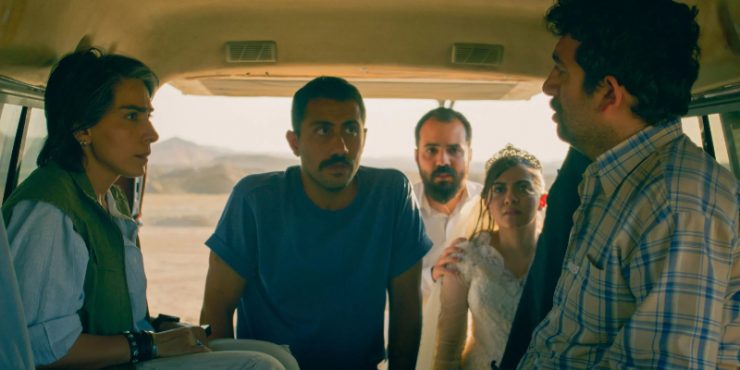
Shiva initially refuses to involve herself in Vadim’s scheme. She has rebuilt her life since her trauma, becoming a wedding photographer. But the mere mention of Peg Leg jars her sense of urgency. When the bride that she’s photographing, Goli (Hadis Pakbaten), overhears the plot, she reveals that she was also a target of Peg Leg’s vicious ways, and demands to be included. Her soon-to-be husband, Ali (Majid Panahi), reluctantly joins. Between the four of them, they still cannot say with confidence whether this is indeed Peg Leg, and Shiva suggests finding the emotionally volatile Hamid (Mohammad Ali Elyasmehr) as the final judge. Even the mention of Peg Leg to Hamid sends him into a tirade, and he wastes little time confirming the identity in a heat of bloodlust. As the caravan grows, Vadim and Shiva agree, the man himself must confess to be Peg Leg before they can follow through with their act of vengeance.
The underlying reticence from Vadim and Shiva battles frequently with the insistence of Hamid, who argues vociferously for killing the man in Vadim’s trunk. The man himself pleads for his life, begging Vadim to believe that he is not the man they say he is. The evidence is circumstantial, but the details (the squeak of the leg, the tone of voice, the smell of his sweat) creates vivid flashbacks for all four of the former prisoners. How each deals with it is what makes the drama in Panahi’s script so fascinating. Vadim and Shiva are led by a moral imperative, subconsciously or not, they understand that perpetuating the violent cycle will not repair their shattered state of being. Hamid and, to a lesser extent, Goli hold less constraint. They want to extinguish their pain in the blood of another, and the slight prospect of killing the wrong man is a risk worth taking.
The group’s squabbles allows Panahi to inject some humor into this tense story. Vadim’s plan was initially quite simple, but it grows in complexity as he brings more and more people into it. The realization of certain practicalities creates unexpected trouble, burdened further by the fact that these are not inherently violent people, but damaged souls desperate to find peace. Will peace be found in extinguishing Peg Leg? That’s the moral question at the center of the story, and Panahi intelligently keeps the answer hazy. The man in Vadim’s truck has a young daughter and a wife pregnant with a second. By all evidence, he’s a dedicated husband and father; does that sound like the life of a former torturer? The cold realization that a family man could also be capable of such heinous behavior is almost more difficult to fathom than the torture itself.
The deeper drama in It Was Just an Accident – beyond the true identity of the man in Vadim’s trunk – is the all-encompassing pain that political violence can bring. Last year’s I’m Still Here was a moving document of a woman who persevered through the government’s attempts to break her spirit. Accident highlights the spirits of those already broken. Those whose paths to recovery are fated to lead right back to the source of their pain. In the decade plus of Panahi’s run of “illegal films”, the director has never shied away from returning to his home country and facing imprisonment. His sterling resolve is not only an element of his superlative character, but a formidable asset within his films. Victims are often forced to accept the accountability that their tormenters refuse to take, and It Was Just an Accident makes that sentiment explicit.
Watching Panahi’s film, you could be tempted to believe these things are innately foreign problems, within the realm outside American stability. And then you remember 2025’s reign of terror from the likes of ICE, Homeland Security, the Trump administration, and the American government at large. When our leaders create an apparatus for arrest and imprisonment beyond due process, our freedom is compromised regardless of whether it happens to us specifically. It Was Just an Accident isn’t merely about what it means to face the boot of authoritarianism, but about the emotional decay that reverberates through everyday life when that kind of cruelty becomes commonplace. Panahi’s film’s have always had a political urgency to them, but Accident will make you run cold when you understand the reality that it states so plain. “It can’t happen here” is an attitude that we can no longer afford.
Written and Directed by Jafar Panahi