





Hedda allows us to see a Nia DaCosta untethered to various Hollywood IP. After her excellent debut film, Little Woods in 2017, she resurrected the 90s horror film Candyman in 2021, before directing the most condemned film of the Marvel Cinematic Universe, The Marvels in 2023 (which I’ve never seen). Her Candyman film excelled in mood, but was saddled with a script worthy of a thirty-year lega-sequel. The Marvels met the wrath of many male MCU fans in a way that really felt out of DaCosta’s control. Hedda is an adaptation of Ibsen’s classic nineteenth century play Hedda Gabler, so I guess you couldn’t say that this film isn’t IP, but it certainly feels like a purer artistic statement than anything else DaCosta has been able to do within the studio system.
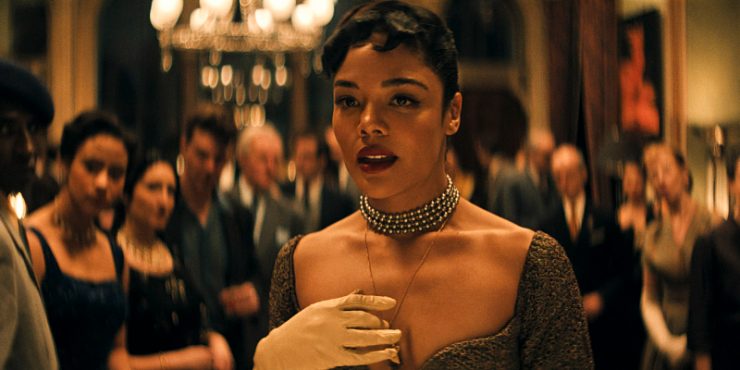
DaCosta is the sole credited writer on Hedda. She moves the story to a somewhat more contemporary time (there’s a Björk song!), while expertly placing the film itself outside of time. Tessa Thompson plays Hedda, the troublemaking housewife bored with her husband, George Tesman (Tom Bateman), and unsuited to the new massive mansion they currently reside in. The Tesmans are stretched financially, and George is depending on an oncoming position as a professor to ensure that they can afford their lifestyle. Hedda takes place during a house party at the Tesman’s mansion, where unspoken truths come to light. The main one comes in the form of Eileen Lovborg (a remarkable Nina Hoss), an intellectual woman who is dead set on getting the very job that George is depending on. Eileen comes with a history of alcoholism that she has worked hard to rehabilitate. She also has a romantic past with Hedda which adds another layer of complexity to her rivalry with George.
Hedda’s enigmatic persona, pinning various parties against one another, adds an extra acidic dynamic to the already tense scene. She manipulates George, Eileen, and others while keeping her own personal intentions hidden throughout. Hedda is an expert evocation of mood, and DaCosta’s use of the mansion gives the story an effectively gothic feel. Thompson’s performance as Hedda – and the thick-as-molasses Mid-Atlantic accent it entails – drags the movie a bit. Thompson is a very technical performer who often shows her work, and it bites against the mystery of how the story should unfold. It’s the incredible Nina Hoss who arrives in the film and takes complete control. The veteran German actress takes the character of Lovborg and steals the play’s sense of tragedy all for herself. Originally a man in Ibsen’s play, Hoss gives Lovborg a sense of masculinity that only adds to her humiliation as she learns she will never be allowed entry into the boys club.
This is a very well-directed film, even if it does feel more like an exercise by DaCosta. Make a small independent film to reset the palette after being the scapegoat for a Marvel flop. This is the “one for her” amidst the sea of “one for them”. DaCosta has 28 Years Later: The Bone Temple coming next year; yet another franchise film. One can’t fault an artist for wanting to make a living. But Hedda is a convincing artistic statement, from a filmmaker who can take classical literature and make it queer and Black in ways that aren’t obvious or showy. There’s an appreciation for the original material that goes beyond its contemporary malleability. One hopes DaCosta will find a similar fulfillment within Hollywood soon, and be allowed more control to flex her technical skill. But I also hope she gets to make more movies like Hedda where the commercial burden is nowhere to be found. It’s a freeing feeling, and watching the best parts of Hedda, you know DaCosta would agree.
.
Written for the Screen and Directed by Nia DaCosta