






In Train Dreams, co-writer/director Clint Bentley gives us a lush view of a quaint American life. The power in the storytelling comes in the contrast between the seeming ordinariness of our protagonist and the vast expanse within the filmmaking. Joel Edgerton plays Robert Granier, a soft-spoken logger making his way through turn-of-the-century America in the Pacific Northwest. Robert has a wife and daughter at home, but their life is sustained by his work which takes him away for long stretches of time in between brief moments of serene domesticity. This bifurcated lifestyle allows Robert a unique vantage point on the world as it drastically changes around him, but it also instills in him a sense of loss for everything that he’s missing.
The film is based on a novella from famed American author Denis Johnson. Like all great short fiction, Train Dreams uses the limitations to its advantage, finding profundity in its sparseness. Robert’s life is not particularly spectacular, he does not possess any otherworldly talents outside of his superlative work ethic. He’s strong by nearly any measurement, but still finds himself vulnerable to the tragedies that can befall everyday life. One such tragedy occurs early in his career, as he worked on the railroad. This work is important, and would play a part in revolutionizing the ways American industry conducted its business, but for Robert, it’s merely a job where he witnessed an act of extreme, racist barbarity made all the more shocking in its casual disregard.
Robert will be haunted by this moment for the rest of his life. He’ll often feel like there’s more he could have done to prevent it. More specifically, he bore witness to the cruelty of a culture while actively working in a project that would make said culture stronger. The moment, short and blunt, will ripple throughout the film. There will be greater, more personally consequential misfortune that will befall him over the course of Train Dreams, but it all stems from this moment. A moment where merely existing felt like original sin. Not long after, Robert chooses to leave the railroad and begin work as a logger, where he spends months at a time exploring the great trees of the Northwest, cutting them down and preparing them for sale. He’ll run into a number of characters, including a talkative explosives expert (a great William H. Macy), a generous, indigenous storekeeper (Nathaniel Arcand), and a dastardly bible-quoter named Apostle Frank (Paul Schneider, in one of the film’s many incredible brief performances).
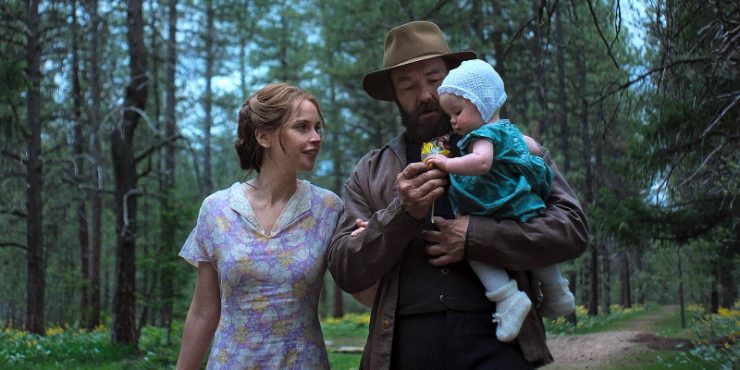
At home, Robert is married to Gladys (Felicity Jones), and with her has a small daughter. The few moments Robert gets to spend with them are the film’s most tender, and Bentley films these sequences with the soft beauty of early Terrence Mallick. Guilt for being away for so long eats away at Robert, and that guilt is not eased by the harsh realities he experiences when he’s back at work. About a third into the film, Robert experiences yet another tragedy that completely unmoors his existence, and he begins to feel like he really is cursed. Whether that be by a merciless God, unbalanced karma, or simple bad luck is never explicitly detailed. Robert doesn’t express himself as superstitious or spiritual, but he’s aware enough to know that life has turned in a very cosmic way.
There’s something truly astonishing about Train Dreams, a film that makes pretty standard observations about our place in the world but manages to present them in truly gorgeous tableaus. And this is a very handsomely made film. Cinematographer Adolpho Veloso finds a real soulfulness within the crisp digital photography, and editor Parker Laramie weaves these gorgeous images into an achingly human story. Bentley never gets lost in the construction of the image, even while they all feel so carefully constructed. Bryce Dessner’s music score pulses throughout, hitting perfect notes of melancholy and triumph without dictating the film’s emotional state. The film would be exceptional simply as a visual experience, but what makes it so special is its impact as a character study.
Bentley co-wrote the script with Greg Kewdar (they also co-wrote last year’s Sing Sing which Kwedar directed). A lot of the novel’s prose is narrated in the film (wonderfully by Will Patton), encapsulating the elegiac tone without any ostentatious exposition. The beauty of Train Dreams is the seamless way Bentley weaves the unmistakable mood without sacrificing the strength of its story. Robert’s existence is an act of physical and emotional perseverance. Plagued by thoughts of his own insignificance, the film consistently makes arguments for his place in this unsparing world. Johnson’s novella is a work of anti-Cormac McCarthyism in this way, and Bentley very intelligently leans into the story’s inherent sentimentality, a decision that only enhances the genuine feelings of Robert’s life.
Edgerton gets one of his best showcases here. The veteran Australian actor has always been a dependable presence. Only two years ago, he was magnificent in Paul Schrader’s Master Gardener, a strong take within Schrader’s long list of antisocial men. Train Dreams is a much softer performance, a brilliant showcase of torturous interiority. Robert is mostly reacting to the characters around him, who move in and out of his life. Of these various figures, Macy’s loquacious dynamite man is a highlight. Macy is doing a Walter Brennan-esque performance, broad and humorous at first glance, with surprise bursts of heartfelt wisdom. His interactions with Edgerton further highlight Robert’s unimposing existence. They are two of the best performances you’ll see all year.
This is a very special movie. A film that attempts to capture the wide swath of the human condition and manages to pull it off. The film’s conclusion flirts dangerously with an overt nostalgia but executes its ending so perfectly, that it never feels unearned. The film premiered at Sundance to rave reviews, only to meet disappointment when it was eventually acquired by Netflix. Many were rightfully mournful that the filmmaking majesty of Bentley’s vision would be limited for most audiences to their home television. This setup works perfectly for me, a new dad with an infant at home who can’t be spared to visit a movie theater. Do I wish that I saw this beautiful movie on a huge movie theater screen? Absolutely. But a movie this special really does overcome perceived shortcomings like that. Home or theater, this is amongst the best films I’ve seen all year.
.
Directed by Clint Bentley