

Few filmmakers feel more coded to the early 2000’s than Paul Greengrass. His handheld verité style lent itself well to the emergence of digital cinematography that “democratized” the filmmaking process and gave many directors a chance to experiment in a more immersive cinematic experience. Greengrass is a good director who’s made good films. 2006’s United 93 was a dangerous venture into actualizing the experience of 9/11 terrorism, and that he pulled that film off at all feels like a miracle. Captain Phillips and News of the World are buoyed by great Tom Hanks performances, but they also highlight the ways Greengrass’s immediate directorial style can compliment a commercial Hollywood project. He may not be as fanatical about his shaky-cam standard (his entries into the Jason Bourne franchise can at times feel physically unwatchable), but he’s clearly still interested in the kind of verisimilitude that a documentary-like style can provide.
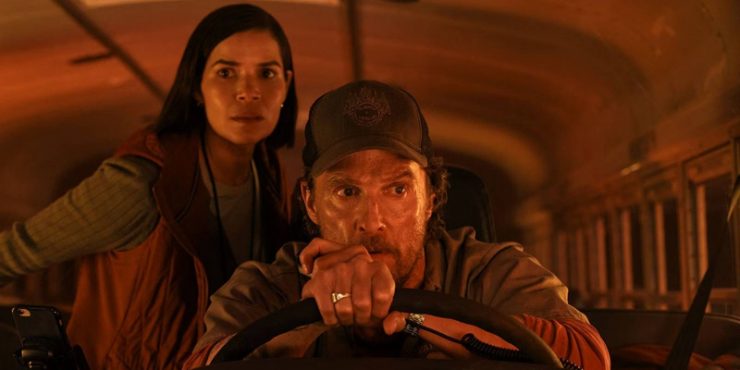
Which is why, when his films are bad, they feel exceptionally so. So many of his scripts (which he occasionally writes or co-writes) are conventionally constructed, and he seems compelled to the challenge of making them feel “realistic”. That his non-Bourne movies are often based on actual events only contributes to his compulsion toward creating a living history. This can produce interesting results, but can also feel like glib experiments exploiting real tragedy. His latest, The Lost Bus, is “inspired” by a true story of a deadly brush fire in Paradise, California in 2018. “Inspired” is probably the worst of the nonfiction idioms that essentially fictional films use to give themselves credibility. In the case of The Lost Bus, a single segment from a Lizzie Johnson’s book about the 2018 camp fire is the source material. It’s meant to be the story of bus driver Kevin McKay (played by Matthew McConaughey), and his treacherous journey to evacuate a busload of children through the engulfing flames.
This is a premise inherently rife with dramatic potential, so it’s a bit mind-boggling that Greengrass (who co-wrote the screenplay with Brad Ingelsby) has decided to flood the film with so much exposition as if the stakes weren’t already so high. Ingelsby is a veteran screenwriter, but his greatest triumph is the HBO miniseries Mare of Easttown, a precisely plotted murder mystery that expertly wove character and story through seven perfect episodes. One gets the sense that Ingelsby is attempting to force several episodes of backstory into a single feature. How else do you explain The Lost Bus‘s first thirty minutes which are comprised almost exclusively with figures telling McConaughey’s Kevin how much of a failure he is? His ex-wife, his son, and even his boss get their digs in on his incompetence, even though all evidence shows that he’s a capable man who’s been served a very difficult set of circumstances (dead father, dementia-riddled mother, dog dying of cancer). This stacking of the deck on his hero’s arc is so obviously telegraphed that the audience that any expectation of authenticity is scrubbed almost immediately.
Once the movie actually becomes about Kevin’s evacuation of the children in the fire, The Lost Bus becomes a much more compelling watch. This is thanks in large part to America Ferrera, who plays Mary Ludwig, a teacher at the school who joins Kevin on his dangerous trek. Mary and Kevin make an odd pairing, but they quickly learn to work together in hopes of saving the school kids from the quickly encroaching fire. Kevin must learn to harness his nervous energy, while Mary must reprogram her pragmatic approach to meet the urgency of the situation. As they traverse various routes that continue to fall apart, Greengrass checks in with the Cal Fire team that does their best to coordinate firefighting and rescuing during a fire that seems impossible to stop. This process-oriented portion of the film is classic Greengrass, who relishes in the uber-competence of professional work. Consider the thrilling sequences of air traffic control in United 93 and you get something similar to these scenes here.
This is ultimately an exciting enough thriller that never overcomes its trope-dependent screenplay. That it relies so often on cheap emotional turns is proof that Greengrass never really had much interest in the story to begin with, but saw a chance to use his handheld fetish and plunge it into the terror of a horrendous natural disaster. And he does do that, even if the weak characterization takes away a lot of the effect that he’s going for. McConaughey can play these kinds of parts in his sleep, and there are times during The Lost Bus where it feels like that’s exactly what he’s doing. Ferrera is the film’s more interesting – and more heroic – performance, and perhaps it feels that way because Greengrass and Ingelsby don’t burden her with a secondary conflict to overcome. The situation on the bus is proven to be enough, and one wishes that a veteran like Greengrass would have realized that more thoroughly.
.
Directed by Paul Greengrass