
The post-modernist novels of Thomas Pynchon seem to defy adaptation. His 1990 novel Vineland feels especially resistant to a non-literary interpretation, dominated as it is by dense, eccentric prose and enigmatic characters. One Battle After Another is cited as being “inspired” by Vineland which is the correct word choice. Nothing is the same – the character names, the locations, the basic sequence of events – and yet everything is. Like Pynchon, filmmaker Paul Thomas Anderson is a talent without precedent. Anderson is skilled enough to homage 1970’s New Hollywood or the melodrama of Sirk or Powell & Pressburger. The paranoid spirit of Pynchon rings true throughout One Battle, but Anderson finds the heart. The novel’s brilliance lies in its cynicism of American institutions. The brilliance of Anderson’s adaptation is how he managed to cobble together some hope without sacrificing the novel’s vision.
This is, of course, Anderson’s second Pynchon adaptation. 2014’s Inherent Vice was paranoid stoner noir that works as an anti-fascist morality play disguised as a lark. Anderson doesn’t work like, say, the Coen Brothers, who are unafraid to make stories of how some things just don’t come together. Anderson is too committed to the power of narrative, even if his visual style is about as experimental as any director working in America today. P. T. Anderson has had the reputation as the US’s greatest director since 2007’s There Will Be Blood, which laid bare the craven greed of American enterprise and featured an iconic performance from Daniel Day-Lewis. That reputation would be a burden for most but it has never stopped Anderson from making the exact movie he wants to make, regardless of the commercial value. Every studio has worked with PTA and all have felt the sting of getting very little box office pay off. How can it be true that no one is better than Anderson but he doesn’t have a single mainstream crossover hit to speak of?
The answer is complicated because the truth is that Anderson has crossed over, even if his films haven’t been at-the-moment successes. Repeated viewings and serious consideration unlock the brilliance of his films, and that can’t be measured by dollars made in a movie theater. So color me surprised when – after nearly thirty years of him being my favorite director – he releases One Battle After Another and suddenly he’s made a film that has grossed over $100 million worldwide. One Battle is the largest scale Anderson has ever worked on, and it’s not like he’s been making particularly small films to begin with. Pynchon’s anecdotal novel about washed out leftist radicals crashing against the rocks of Reagan’s 1980s is turned into a thrilling action comedy with astonishing set pieces and the forward propulsion of something like Mad Max: Fury Road. This is one of the fastest 142-minute films you will ever see in your life.
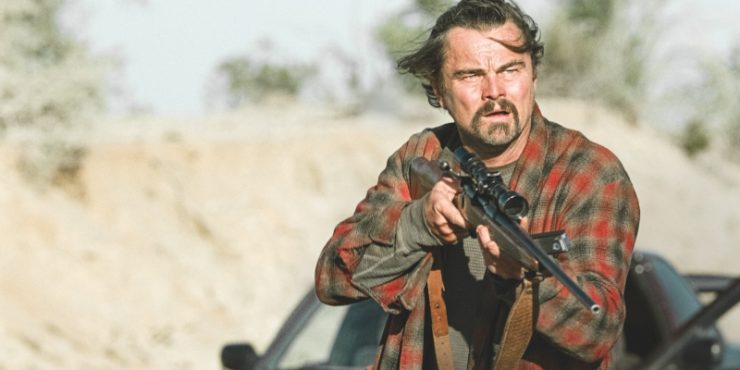
One Battle‘s star is Leonardo DiCaprio, who plays Ghetto Pat, a member of leftwing revolutionary group called The French 75. Pat’s specialty is explosives, which helps the group in their robbing of banks and raiding of immigrant detention centers. Pat is in a love triangle with fellow French 75 member Perfidia Beverly Hills (Teyana Taylor) and the grotesque Army Colonel Steven J. Lockjaw (Sean Penn). Lockjaw’s moral compass is completely bereft, but overcome by lust, he begins an affair with Perfidia, which the revolutionary pursues. When she has a child with Pat, her own sense of self begins to spiral, and she disappears, leaving Pat and their baby daughter to flee to a cabin off the grid with new identities: Bob and Willa Ferguson. Also mourning Perfidia’s disappearance, Lockjaw attempts to bury his true feelings (a proper racist, he is thoroughly ashamed of his uncontrollable feelings for the Black Perfidia), though his hopes of finding the father and daughter stays with him for over a decade.
This sequence – the film’s first thirty-five minutes – is one of the film’s most masterful. Similar to prologues in There Will Be Blood and The Master, Anderson is weaving an entire feature’s worth of storytelling in one fluid motion. It tracks the rise and fall of the French 75 in the late 2000’s, while also perfectly sculpting the relationship maps that connect Pat-turned-Bob with Perfidia and Lockjaw. We also meet Deandra (Regina Hall) the only other major French 75 member able to escape Lockjaw’s scorched Earth hunt for the revolutionaries. At the prologue’s end, we’re witness to a breathtaking cut, which spans over 16 years and introduces us to the teenaged Willa (Chase Infiniti), getting karate instructions from Sensei Sergio St. Carlos (Benicio Del Toro). Cued to Steely Dan’s “Dirty Work”, the elongated introduction is a breathtaking feat, all the more impressive by what it implies: And now the real movie is about to begin.
The main plot, such as it is, revolves around a current-day Bob Ferguson, whose paranoia over Lockjaw’s return has manifested in a sixteen-year bender of weed and alcohol. This comes at the expense of his relationship with Willa, whose attempts to live a life of a normal teenage girl is often at odds with her fathers strict levels of secrecy. They live in a cabin in the sanctuary city of Baktan Cross with no cell phones and no internet. Meanwhile, modern day Lockjaw is on the precipice of one of his greatest ambitions, becoming a member of the exclusive secret society, The Christmas Adventurers. The society’s most prominent member (Tony Goldwyn) explains what membership entails: a complete and total commitment to the purification of a white American state. Realizing that his connection to Bob and Willa is the final strand that connects him to his relationship with Perfidia, Lockjaw reignites his fervor in finding the last two people who could prove that he once had sex with a Black woman.
Lockjaw is given what seems like the full power of the military to infiltrate Baktan Cross and fish out Bob and Willa. Willa is retrieved by Deandra, who explains her connection to her parents and quickly absconds her to a rendezvous point where they will meet Bob. Unfortunately for Bob, he is too stoned to remember the strict pass code system that the French 75 use for proper extraction. He’s forced to ask for help from Sensei Sergio, who we quickly find out is running his own form of political action (“I’m running a bit of a Latino Harriet Tubman situation” he explains). Together the men escape an increasingly violent situation across Baktan Cross where anti-fascist protest is met with unrestrained state violence. Hoping to find Willa before Lockjaw, Bob struggles to return to his earlier form as a stealth underground agent, fighting against years of drug and alcohol abuse to protect his daughter once again.
One Battle After Another has many strands, and Anderson is a director confident enough to see those strands to their full potential. Once the story starts in earnest, the film splits its perspective between Willa and Deandra, Bob and Sensei Sergio, and the fierce Lockjaw. Lockjaw has the wide swatch of American military might at his back, but Bob and Willa have the solidarity of true mutual aid. Much has already been made of One Battle‘s political relevance to today’s modern Trump-ian fascism, so the film’s projection of a group of fearless rebels taking on an encroaching police state (and all the racism that entails) is quite moving indeed, even as we see their inevitable disbanding early in the film. Perhaps most astutely, Anderson’s prologue takes place in the Obama years, and the movie itself was produced and shot during the Biden administration. This is a bipartisan political observation: regardless of which party is in power, the continued militarization of the police has only added to our collective dehumanization.
Over a decade past the peak of his relevance, it’s perhaps difficult to remember that Sean Penn was once considered a generational acting talent. Since 2020, he’s probably known most for being something like a liberal Mel Gibson, spouting outrageously obtuse and controversial political opinions that make little to no sense outside of his warped, elitist mind. All’s to say that Penn has become something of a grotesque and something of a paradox as a public figure. Which is why his casting as Lockjaw is so perfect. Not only does Penn successfully remind you that he is a formidable talent, but he crafts a character that cuts to the quick of the MAGA conservative male. He’s an obsessive sadist. If he can’t do something cruel, he won’t do it at all. But that sadism is dictated by shame, with a passion undone by his own racist ethos. Against the odds, Anderson manages to find moments where Lockjaw’s pathetic striving for emotional contentment engender something close to pity.
Lockjaw and the Christmas Adventurers storyline is the movie’s most outwardly Pynchonian conceit. As outrageous as he might seem as a character, it’s based in the insanity of our current society. DiCaprio, living out what he calls a lifelong dream of finally working with Anderson, gives a vanity-free performance as Bob. Since 2019’s Once Upon a Time in… Hollywood, Dicaprio has specialized in these roles that poke holes in the severity of his public persona. His performance here seems like what his past thirty years have all been leading up to. Work so fully committed to serving the story that one does not become preoccupied with DiCaprio’s offscreen life. Bob is the film’s hero, but his heroism is not in what he accomplishes but in the persistence of his effort. He proves himself to be outmatched in every fashion, but that does not stop his single-minded journey to rescue his daughter from Lockjaw.
The movie’s third act is the most thrilling thing Anderson has ever produced, set with an action set piece fit for the early 90s classics like Speed or Terminator 2: Judgment Day. Once again, expectations are defied and the showdown you’ve been waiting for ends up being something totally different. It’s Chase Infiniti’s Willa who ends up becoming the film’s most outright hero. A statement of hope that a future generation won’t fumble at the goal line the way the French 75 did. In her first ever film role (some may recognize her from AppleTV+’s Presumed Innocent miniseries), Infiniti gives a star-making performance as a teenager who wishes to be anything but what her father raised her to be. What’s so incredibly moving about the film’s conclusion is that everything Bob taught her is ultimately what she needs to survive Lockjaw and all the other cretinous figures who come after her over the course of the movie.
This is probably the moment where I mention that I myself have become a father and this is the first time I’ve been to a movie since my son was born last month. I’m not ashamed to admit that this framed my viewing of the film, and deepened my emotional connection to Bob and Willa’s story. I’m not unique here, but it speaks to the specialness of a great film, which One Battle After Another definitely is. They touch on what makes us human, whether that be the endless fear you have over your children (Bob), or the personal denial of your own personal identity (Lockjaw). The two men at the head of this movie give you two different versions of what it means to be a father, and Anderson (who has four children of his own) is making his own statement on which course is the one to take. There are broken families all over PTA’s filmography, and they create the broken characters that populate his scripts. One Battle After Another offers us a family that may be imperfect, but is dictated by devout dedication and love. It’s moving to see Anderson head in that direction, and to infer that dedication and love might be the only thing that can save us from what’s coming.
Written and Directed by Paul Thomas Anderson