
One may look at the premise for Blue Moon – a real-time dramedy about Lorenz Hart monologuing against the dying light – and feel it’s too constrained; better set for the stage than for the screen. And that would probably be true for most single-setting movies, but this film is directed by Richard Linklater, a director who has made a career out of expertly making drama out of the very passing of time. Blue Moon also reconnects Linklater with his most famous collaborator, actor Ethan Hawke. Hawke and Linklater share this obsession with time, how it warps itself around our personal dramas; and Hawke’s performances in films like Boyhood and Before Sunset measure perfectly against the sense of fleeting mortality that Linklater is trying evoke. That Blue Moon may also count as something of a biopic doesn’t really distract from what they’re doing here, which is making a film about an artist who thinks he can cheat the passage of time by opining on it. Sound familiar?
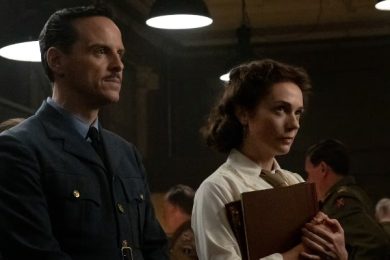
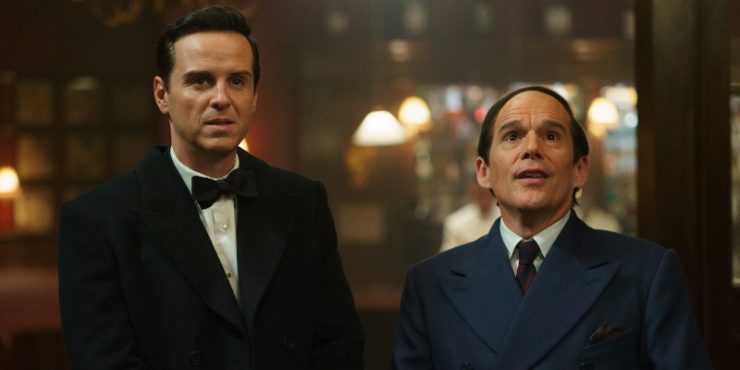
Hawke plays Hart, the legendary lyricist whose collaborations with composer Richard Rodgers produced timeless hits like “My Funny Valentine”, “The Lady is a Tramp”, and (of course) “Blue Moon”. Hart is a man of diminutive stature but his appetite is voracious, for booze, for people, but most importantly for conversation. Hart’s alcoholism caused a schism between he and Rodgers (Andrew Scott), and the events of Blue Moon take place after the Broadway premiere of Oklahoma!, Rodgers’s first of many collaborations with lyricist Oscar Hammerstein II (Simon Delaney). Hart slinks out of the theater before the performance ends and heads down the street to Sardi’s, where he holds court at the bar with Eddie the bartender (Bobby Cannavale) and the local piano player, Morty Rifkin (Jonah Lees).
Hart’s distaste for the show is made obvious, hardly hiding his resentment that his former partner has found such astounding success so quickly with someone new. His sour grapes come out in charmingly hilarious anecdotes and cheeky turns of phrase that keep the barkeep and musician attached to his every word. The one good thing going for Hart is his relationship with a young woman named Elizabeth (Margaret Qualley), a twenty-year-old poet who counts herself as his protege. It’s an open secret that Hart is queer, but he continues to wax on about his obsession with Elizabeth, who he hopes to finally have sex with after his night at Sardi’s. Despite his sexuality, Hart obviously sees Elizabeth as an inspiring alternative to his current state of emotional disappointment and creative stagnation. No one really believes that he can close the deal with the young, beautiful Elizabeth, but that doesn’t stop Hart from trying.
When the entire Oklahoma! team joins Hart at Sardi’s to toast their instant success, Hart expertly weaves through the crowd, showering everyone with backhanded compliments and faint praise. Speaking with Rodgers, Hart overextends in his celebrations in hopes of getting his former partner back in the fold. The reality is that Rodgers would be more than happy to work with Hart again, but can’t deal with the volatility of the songwriter’s various vices and insecurities, his inability to maintain order or be dependable. Hart’s frequent conversational filibustering often argues against his own irrelevance, and he speaks with a desperation that shows that the person he’s trying most to convince is himself. In the film’s opening, we learn that Hart dies only seven months after the events of Blue Moon, a fact that colors his repertoire of witticisms with heavy melancholy.
The film’s script is written by Robert Kaplow, and it has the tidal flow of a great piece of stage work, and I don’t doubt this would work well as a play. But I’m glad Linklater got the chance to make this as a film. When writing about Nouvelle Vague – Linklater’s other 2025 movie – I spoke of him as a director more interested in intellectual pursuits than visual ones. Blue Moon is the more successful film of the two by a good margin, and it’s the one that leans more into the larger thesis of Linklater’s career. The arc of Hart’s time within Sardi’s fluctuates between triumph and humiliation. There’s a nobility to the way he defends himself against being “washed up”, even if we know he’s got no chance of real rehabilitation. One of the better sequences of the film involves him speaking with beloved author E.B. White (Patrick Kennedy) about the tragedy of waining creativity. White is on the verge of great commercial success with Stuart Little and Charlotte’s Web, while Hart is on the precipice of death; but listening to the conversation, you’d think it was the other way around.
Which leads me to Hawke. As a child, Hawke was a 90s heartthrob, the gritty hunk of Reality Bites and the angsty Hamlet. He was always a talented performer, but I never foresaw him becoming one of the purest American actors of his generation. Getting older has given Hawke incredible creases in the face and gravel in the voice. His performances in films like 2018’s First Reformed and 2020’s Tesla showcase him as a talent with range and depth, while his interviews prove him to be one of the most eloquent voices out there on the nature of artistic creation. Blue Moon latches beautifully onto his talent for elegant articulation and forceful rhetoric. There’s also impersonation, sure, but also the sheer quantity of dialogue is staggering – if you could call it dialogue, considering how much of the words Hart consumes for himself. Hawke tears through said words with great hunger, all while adding the vulnerability, a crucial element that cuts against the self-hating vulgarity.
What is Hart after in his pursuit of Elizabeth? When we finally see them together, they speak about her exploits with other men in ways that confirms she has no interest in him in that way. Does he really not see that? Hawke and Linklater so cleverly disguise Hart’s levels of delusion. His heart breaks not for the affections of a college student, but for the cultural power he used to possess. And yet, as you continue to watch his vicious, but ineffective attacks against the success of his peers, he actually becomes something close to sympathetic. This is one of the best performances of Hawke’s career, a genuinely funny turn that lets the humor crash tragically into the thudding reality of Hart’s actual history. In Blue Moon, Hart is a man setting himself up for anguish in a way so obvious, you wonder if he’s just doing it for the attention. And if he is? That’s an irony that Hart could truly appreciate.
.
Directed by Richard Linklater