



Richard Linklater is a filmmaker defined by his refusal to be defined. He’s one of the most beloved figures of the 90s indie revolution, but has proven quite capable of producing good Hollywood films. He’s got profound masterpieces on his resume, as well as head-scratching experiments. Like many of his Gen X peers – Steven Soderbergh or Gus Van Sant to name a couple – he appears more motivated by trying something new than making something of surefire quality. His obsession with the function of time (Boyhood, the Before trilogy of films) has colored some of his most groundbreaking work, but he’s just as comfortable producing audience-pleasing comedies (School of Rock, last year’s Hitman). In keeping with his prolific nature, he has two movies in the Fall of 2025. One of them, Nouvelle Vague, just premiered on Netflix and covers one of the most important movies in the history of film.
“Nouvell Vague” is the evocative name referring to the group of 1950s French critics-turned-filmmakers whose analytical approach and self-referential style revolutionized the way films were made across the world. In America, we call them the French New Wave. The most famous of the New Wave directors is Jean-Luc Godard, and the most famous of his films is his 1960 debut Breathless. Starring iconic French actor Jean-Paul Belmondo alongside the beautiful American actress Jean Seberg, Breathless completely redefined the way a movie could be, with its crude jump cuts and DIY production. To this day, the film emanates an effortless cool impossible for audiences to resist. The modesty of its filmmaking belies an aggressive artistic sensibility, which is why it’s still the most accessible film that Godard ever made.
In Nouvelle Vague, Linklater has decided to make a movie about the making of Breathless. It’s a story that is genuinely compelling, filled with important characters in film history. Godard’s personality, famously cantankerous and exacting, is less charming before becoming the most famous director in the world, and he meets great resistance from those who fail to see his vision. But Nouvelle Vague never really overcomes the great question of “why”. Why make this film about this movie? Why take a piece of art so unmistakably groundbreaking and filter it through a movie so standardly presented? Linklater is a talented enough storyteller, and the figures involved are all interesting enough people, so the film is never flagrantly boring or obtuse, but the film never escapes the overbearing sense of pointlessness around the entire exercise.
Guillaume Marbeck plays Godard, the sunglasses wearing enfant terrible who worries that his chance to be a filmmaker has passed him by. His Cahiers du cinema peers, like Francois Truffaut (Adrien Rouyard) and Claude Chabrol (Antoine Besson), have all graduated from written critique to respected directors, but he has yet to break ground on a film. He settles on a script from Truffaut, a pulpy number about a criminal who kills a police man and hides out with his American sweetheart in Paris. Producer Georges de Beauregard (Bruno Dreyfurst) bankrolls the film expecting Godard to produce a crowd pleasing genre film, but Godard has other ideas on his mind. He casts his friend Belmondo (Aubry Dullin), and is able to convince American actress Jean Seberg (Zoey Deutch) to join as well. Seberg is far from a star but she’s known in Hollywood, having worked with the likes of Otto Preminger.
The actors and crew aren’t given a script and the production lies at the whims of enigmatic Godard who will wrap a production day after only an hour if he doesn’t feel inspiration springing within him. As he shoots, he disregards people who point out issues of discontinuity or jumping the 180 line. His outbursts are petulant, and his arguments difficult to parse. This all rankles Beauregard who quickly feels the financial gamble on Godard will turn into a huge bust. As production proceeds, Godard’s process never becomes clearer, even as his conviction grows, but cast and crew alike begin to get the sense of excitement that he is trying to inspire. Even into post-production, Godard refuses to play by the standard rules, impressing onto the editors to make cuts regardless of proper sequence. The result is Breathless, a movie as undeniable as any ever made.
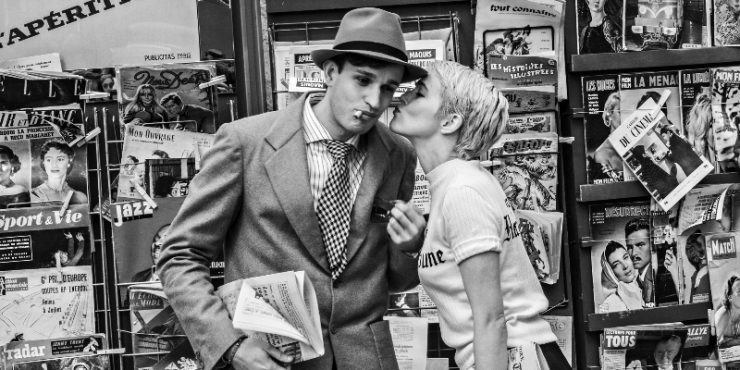
One way Linklater attempts to liven up the story is by producing it in the style of the New Wave. Shot in black & white, in the 4:3 Academy ratio, Nouvelle Vague really does evoke the early days of Truffaut, Godard, et al. Recording the dialogue in a chunky dub (or at least, very much making it sound that way) is another detail that solidifies the setting. This is a flex of style from a director who’s not always known for it. Linklater is a much more intellectually stimulating director than a visually arresting one. Nouvelle Vague shows what he’s capable of as a stylist, but it only reinforces how lukewarm this film is compared to the one that its depicting. As much it tries to hide it, this is an incredibly conventional film, trying to tell the story of a film and an artist who were anything but.
At the film’s conclusion, Linklater allows himself a flourish of sentimentality that Godard would have absolutely hated. And yet, knowing what we know about Godard, he would have admired the audacity in doing it. Like Bob Dylan, Godard was a legend that always flourished within his own unpredictability. To a lesser degree, Linklater himself was a significant figure in a major cinematic movement, so he knows something about the nature of artistic revolution. That this doesn’t reflect at all on Nouvelle Vague is one of the most disappointing parts of the movie, which is ultimately an entertaining enough collection of performances and scenes. Perhaps the film will convince someone to watch Breathless who hasn’t already – and that probably answers the question of “why” make the movie at all. Unfortunately, there’s no better argument for Breathless’s relevance than the film itself, which Nouvelle Vague only makes more clear.
.
Directed by Richard Linklater