





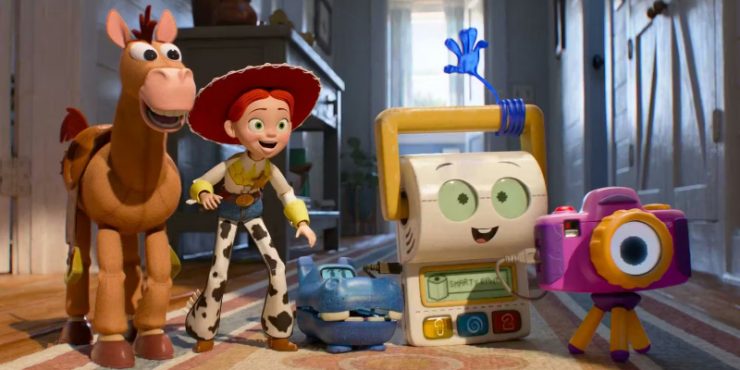
It’s difficult, now, to illustrate the revolutionary impact of the first Toy Story film on movie audiences back in 1995. I was six when the film was first released. In other words, I was the exact audience that the movie was looking to capture. The first feature to come from the now titanic Pixar Animation Studios, it’s visual style was completely unlike any animated film seen before, and that combined with a near-perfect screenplay produced one of the most enduring films of the Twentieth Century. Thirty-one years later, Toy Story 5 arrives in theaters. Only five films in three decades does show some restraint, sure, even if this recent installment does feel like spinning its wheels. Pixar is not the unstoppable force it once was in the 2000’s, but Toy Story is still their signature franchise. Returning to the well can feel desperate, so it’s a more-than-pleasant surprise that this film is as delightful as any in the franchise.
Toy Story 5 is directed by Andrew Stanton, the Pixar veteran behind masterpieces Finding Nemo and WALL-E. Stanton is a one-man metaphor for the studio itself, with his incredible highs and sobering lows (his John Carter film is perhaps THE go-to box office bomb of the last twenty-five years). This is the first time he’s directed a Toy Story movie even though he was instrumental in the development of the first film. Toy Story 5 feels like a recalibration for both filmmaker and studio, a return to the foundational elements that have made Pixar’s storytelling machine so effective. The first major decision? Taking Joan Cusack’s Jessie and making her the screenplay’s main character. Sure, we still have Tom Hanks’s Woody and Tim Allen’s Buzz Lightyear, but Stanton expertly (and boldly) recognizes that Jessie is this series’ best chance for a fresh perspective.
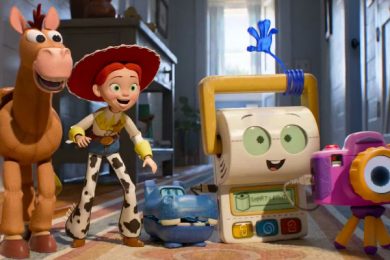
Jessie, Buzz, and the gang are still where we left them in the fourth film, with Bonnie (Scarlett Spears), a socially-reserved eight-year-old girl who struggles to make friends with local kids. Bonnie still loves creating elaborate scenarios with her toys, but her peers instead find solace in the glowing light of the screen, whether that be a smartphone or a tablet. Anxious and lonely, Bonnie begins to worry that she will become alienated by he fellow kids, and in a desperate move, her parents buy her a Lilypad (voiced by Greta Lee), a frog-themed tablet that not only provides Bonnie with learning games to play, but also promises to help Bonnie communicate with children her age and make friends. It’s not long before Bonnie is completely entranced by the tablet, completely abandoning her beloved toys and giving herself over to the world of tech and the toxic emotions that that brings.
Lily, as the Lilypad calls herself, has a droll disdain for the gang of toys, and often speaks to them with condescension. She sees Jessie and friends as an impediment to Bonnie’s eventual social circle, blinded to the effect she has on Bonnie’s outsized imagination. Desperate, Jessie finds a way to communicate with Woody, to get him to return and assist with dispatching Lily. Woody’s return – at Jessie’s request – rubs Buzz the wrong way, as he spends most of the movie trying to find a way to ask Jessie to marry him (a recurring motif in this film: toy weddings). As such, old rivalries reignite between the old friends, but even before Woody comes back, Jessie and her horse Bullseye find themselves transported to a farm house in a failed attempt to force their way into a sleepover between Bonnie and her new Lilypad friends. It ends up being the same farm house Jessie lived in decades before, when she lived with her first child, Emily. These days, a new family lives there, including the young Blaze (Mykal-Michelle Harris), who shares Bonnie’s love of toys.
Joining forces with Blaze’s abandoned potty training toy, Smarty Pants (Conan O’Brien), Jessie begins to learn that a little bit of tech may be helpful for Bonnie, if only to get her introduced to Blaze, a possible friend who may share Bonnie’s love of playing with classic toys. Stanton shares screenwriting credit on this film with Kenna Harris, and one can certainly see the man who wrote the blobby human race in the second half of WALL-E’s signature here. There is a surprising acidity to the way Stanton views the predatory nature of screens on the imaginations of children. This is hardly a unique observation, but it’s still a surprising tact in a Disney film, especially from a filmmaker who has worked directly with Steve Jobs. Ultimately, Toy Story 5 does stop short of making a true enemy of the Apple corporation, but like in WALL-E, Stanton provides more cogent social commentary than you would expect from a children’s film without sacrificing the innocent nature of the storytelling.
Which is always the fear as these Pixar movies reach their fourth decade. At their peak, Pixar enjoyed a rather haughty status with a reputation for being a more mature, cerebral collection of animated children’s films. As their success increased, so did their need to outdo themselves. By the time we got to Toy Story 3 in 2010, it already felt like the films were being made for the now adult 90s kids. Once we got to Inside Out, it was clear that Pixar put great stock into being enjoyed by adults as much as children. And I’m not saying that films can’t be for both, but Pixar’s key-dangling toward millennials was beginning to feel pandering. Toy Story 5 feels appropriately descaled in this regard, a more focused view of the toys and what their function ought to be. The degree to which Woody, Buzz, and Jessie are all surrogate parenting figures for their child owners has always been a theme in the series, but Toy Story 5 makes the gang more singularly focused on the things they love most: being played with.
Ultimately, Toy Story 5 is less cutting than even WALL-E in its criticisms of tech’s influence on young children. There is legitimate danger there, but this film’s characters find themselves compromising much in the way that I imagine Stanton and the filmmakers had to compromise to simply get the film made. In the end, I am but a millennial, so I am no match for the appeals to nostalgia that Stanton makes here. I could (and would) argue that he doesn’t lean on that nearly as much as you’d expect, but must also admit that I’m so thoroughly bought in on these characters that I wonder how much my judgment is kicking in there. Like all of the great Pixar films, there’s a devastating emotional effectiveness in the screenplay that plays upon our inner child with heartbreaking results. You see the strings being pulled, but, as usual, you still admire the skill with which it’s executed.
.
Directed by Andrew Stanton