






For a directing pair that hadn’t made a film in twelve years, Phil Lord and Christopher Miller have certainly put their stamp on Hollywood. Their filmography, which includes the animated films Cloudy with a Chance of Meatballs and The LEGO Movie, as well as 21 Jump Street and its sequel 22 Jump Street, is a healthy combination of sound script construction with rat-a-tat joke frequency. The fact that one almost never steps on the other was especially impressive – a more kinetic version of that Joss Whedon feeling. When they were fired by Disney off of Solo: A Star Wars Movie, the unspoken theory was that they were in a soft director jail (insanely, its rumored they were fired for making Solo too funny). The flotsam of that production was left to Ron Howard who made a Frankenstein’s monster where you watched it and thought “Well, I really enjoyed the parts that were obviously Lord and Miller’s contributions”.
Project Hail Mary is their first film since that mishap, though they’ve had a stellar run of producing animated films like both Spider-Verse films and Mitchells vs. The Machines, all particularly well-made productions that had that “Lord and Miller touch”. Hail Mary is not an animated film. It’s a live-action adaptation of a best-seller by sci-fi writer Andy Weir, best known for writing the novel The Martian. The Martian itself became a massive Hollywood hit in 2015, and Hail Mary follows a similar formula. Both follow a man alone in space who must face enormous odds against survival, with his main tool being his vast scientific knowledge and intelligence. The script for both The Martian and Project Hail Mary are written by Drew Goddard, himself a Joss Whedon acolyte who excels at melding humor into dense plotting. In both instances, Goddard is transposing Weir’s hard science into the script, and surprisingly, that has not harmed the commercial prospects of either film, even if it does relegate much of the story to perfunctory processes.
The similarity in plots between his two novels only reinforces Weir as a writer who uses his books to forefront his own knowledge of complex concepts, a trait that only becomes more pedantic by Goddard’s “well, that happened” brand of humor. It’s perhaps a red flag that Neil DeGrasse Tyson stated that The Martian is one of the few commercial sci-fi movies where he can’t complain about inaccuracy. The first shift that Lord and Miller make with Hail Mary is to make it more outright a comedy, which makes the choice of Ryan Gosling as the film’s main star particularly appropriate. The narrative that movie stardom has somehow alluded Gosling was always a misguided theory that required cherry-picked statistics in order to be true. If Barbie was a commercial “comeback” for Gosling, then Hail Mary’s unqualified box office success closes the book on the argument – the film opened primarily on the strength of his name, and it will likely fall amongst the highest-grossing movies of the year.
Gosling plays Ryland Grace, a middle school teacher who’s courted by Eva Stratt (a terrific-as-usual Sandra Hüller), the leader of a task force putting together “Project Hail Mary”. The project is meant to identify and hopefully solve the “Petrova Line”, a beam of infrared light extending between the Sun and Venus that appears to be dimming the Sun. Grace’s background as a former molecular biologist who wrote a controversial paper that theorized alternative life forces makes him, in Eva’s eyes, the perfect person to examine “Astrophage”, the living material that appears to exist within the Petrova line. It’s Eva who reveals to Grace that the Sun is, indeed, dimming and that society and general human existence will be extinguished within a century if a solution isn’t found. The only idea they have? Send three astronauts to Tau Ceti, the one local star that doesn’t appear effected by Astrophage, and have them report back to Earth with information. It’s a one-way mission where the three chosen know that they will be unable to return to Earth.
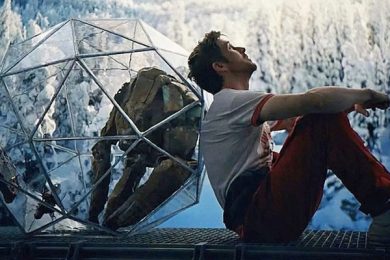
Important to note that all of this is explained in flashback. The movie actually opens with Grace awakening from aboard the Hail Mary space craft on its way to Tau Ceti. His memory on how he became one of the three on the ship is hazy, but he quickly learns that he’s the only one still alive. Through much trial and error he begins to put the pieces together about what he needs to do and why he needs to do it. Early in the movie, Grace is contacted by another nearby ship that begins sending messages that he can’t decipher. Eventually the ship docks onto the Hail Mary and Grace reaches out to meet Rocky, a rock-spider-like creature of increased intelligence. Rocky and Grace spend a good amount of time building the tools to communicate with each other before realizing that they are both on the same mission for their respective planets. They then agree that pooling their knowledge and resources together can help save both their worlds from extinction.
Project Hail Mary then becomes a parallel narrative. One is a buddy comedy between Grace and Rocky as they take their chances trying to find an antidote to Astrophage. The other is told in flashback, showcasing Grace’s involvement with Eva on Project Hail Mary, and how that evolves into him being on the spaceship after all. Both storylines depend on Gosling’s chemistry with his co-star not only for humor but ultimately the entire emotional crux of the screenplay. It’s quite a boon to Hail Mary that Gosling is a performer who’s perfected the skill of being a screen partner. Gone are the days of hardened stoicism like First Man and Only God Forgives. Gosling now is expressly collaborative, finding the power of his characters against the performance of another. All while still maintaining the screen presence of a real star. You don’t really think of Gosling as an everyman school teacher the way you buy Matt Damon as an everyman astronaut in The Martian, but because Hail Mary works at a much higher key, his outsized figure fits perfectly.
Their previous efforts established Lord and Miller as filmmakers of remarkable pacing and tone. Solo was meant to be their introduction to the Hollywood blockbuster. Instead, Project Hail Mary serves as their first official major studio movie they’ve released. The film is shot by Oscar-winner Greig Fraser, the Aussie cinematographer behind 2022’s The Batman and both of Villeneuve’s Dune films. Fraser helps give the film some remarkable scope, crafting a wondrous space landscape without sacrificing the intense hostility of the setting. Equally impressive is the music score of Daniel Pemberton, which beautifully highlights the movie’s quick shifts in tone and gravity. A sequence late in the film where Grace follows Rocky into a new setting is a high point, highlighting the degree to which Lord and Miller, and their collaborators, have executed such a bravura vision.
The Andy Weir mode of storytelling will never be my cup of tea. The explicitness of the characters’ competency does a good job of setting the sky high stakes, but also sacrifices suspense. Movies like these seldom have the guts to land on outright tragedy. The fun is often in watching how skillfully the script will dodge it. Goddard’s script is a bit clumsy in that regard, often with a desperation to stick to the text of Weir’s novel. Lord and Miller give the movie much-needed grace notes (no pun intended), often between Grace and Rocky, but also including a scene where Hüller’s Eva sings karaoke much to the surprise of the rest of the team. The two directors prove that they can prioritize character even in a film this large and, probably more importantly to them, they’ve proven that they can helm a major blockbuster production… without getting fired. Seeing how they respond to this victory lap is the kind of stuff movie nerds (like me) live for, but one hopes they’ll one day return to a scale that further highlights their gifts for interpersonal comedy.
.
Directed by Phil Lord and Christopher Miller