





Musician-turned-filmmaker Boots Riley is proving to be Hollywood’s most audacious, leftist iconoclast. Seems like a contradiction in terms, which is perhaps why his films take no chances on being misconstrued. His first film, 2018’s Sorry to Bother You, was an energetic satire about the ways racism and classism is the double-headed spear that capitalism plunges into the working class. In its second half, Sorry flips into a grotesque level of absurdity that really challenges its audience – have a good time with this movie, sure, but remember the bleakness of our reality. Riley’s latest film, I Love Boosters, is bigger and brighter, with more name actors and a larger scope. It follows a similar track to his first film: hilarious and outrageous, but ultimately righteous in its political messaging.
Boosters has an ensemble cast but its main star is Keke Palmer. Palmer has been acting professionally since she was a child, but it was Jordan Peele’s 2022 masterpiece Nope that showed audiences that she had the screen charisma and the acting talent to be a real star. In the four years since, there hasn’t been a whole lot of capitalization on that. The exception being last year’s welcome January hit One of Them Days, which was a more conventional comedy albeit with very similar themes to Riley’s I Love Boosters. Both movies lean into Palmer’s comedic gifts, which are both behavioral and physical, while still unlocking her unequivocal stardom. Palmer has the gift of approachability despite having movie star beauty. She can play an underdog and still feel like an aspirational character.
She indeed plays an underdog in Boosters as Corvette, an aspiring fashion designer who makes her money as a “booster”. That means she steals clothing from high end stores and resells them within her community at a steep discount. People are hurting for spending money, so Corvette and her team provide luxury at a much more reasonable cost. This Robin Hood-like operation can be spun as a form of community service, but Corvette’s ambitions are not charity. She wants to live the luxurious life that these clothes represent. Her idol is Christie Smith (Demi Moore), a wildly successful designer whose girlboss politics cosplay as progressive, but her own personal politics (and the workplace policies she oversees) reveals a high disdain for the working class people who desire her product.
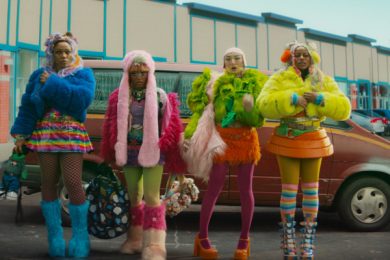
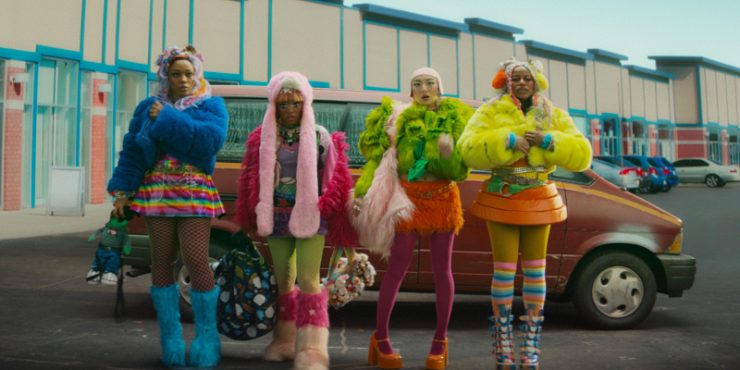
Corvette has read Smith’s bestselling memoir several times and aspires to her level of success. That said, Smith’s store chain, Metro Designers, is the main target of Corvette’s boosting. Corvette’s crew is known as ‘The Velvet Gang’ and includes her two friends, the flighty but genuine Mariah (Taylour Paige) and the more pragmatic Sade (Naomi Ackie). Along with a few unnamed men and usually one white woman (important for employee distraction), the three friends often make off with hundreds of dollars in merchandise at a time. When the gang discovers that Metro Designers is selling one of Corvette’s rejected designs, they cook up a new scheme: get jobs at one of the stores and completely clear it out.
The monochromatic store is managed by the manic Grayson (Will Poulter), who is exacting in his adherence to company policy. This grates on the misanthropic Violeta (Eiza Gonzalez), who tries to convince the newly hired Corvette, Mariah, and Sade into organizing labor action. The Velvet Gang prefers to stick to their original plan of simply robbing the store when they’re beat to the punch by a Chinese sweatshop worker named Jianhu (Poppy Liu), who manages to make the store’s entire inventory vanish in a matter of minutes. But how did she do it? This is where Boosters evolves from a quirky comedy into an absurdist tale of capitalist exploitation and working class solidarity. If selling stolen clothes to their urban communities is the gang’s idea of philanthropy, they’re about to learn the true power of collective action.
Riley’s chromatic brand of filmmaking feels unbound even amongst our edgiest auteurs. He is unapologetic about his Marxist principles, which makes it kind of a miracle that a film studio would even be willing to fund his visions. (This is funded in part by Megan Ellison’s Annapurna Pictures; Megan being the sensible subsidiary within the Ellison family which is currently attempting hostile, right-wing takeover of all US media.) His scripts are skillful in their weaving of socialist language within the zany farce, and he understands that citizens vote with their dollars just as much (if not more so) than they do with their ballots. That explains why he has made such a passionate plea on social media for as many people to watch this film in theaters as possible.
But while I Love Boosters may appear at first glance like an offbeat commercial play, Riley’s film is incredibly strange, in ways both admirable and puzzling. This all contributes to the fuller picture of what Riley is attempting to say, and it makes the script courageous and uncompromising, if at times alienating. All’s to say that I worry about this movie finding its audience as the metaphors become more and more outrageous. Take for instance a plot line involving a handsome, mercurial young man played by Lakeith Stanfield. Stanfield’s nameless character encounters Corvette numerous times throughout the film, and each time places her in a short but intense spell. His desires aren’t totally clear at the start and Riley has a lot of fun revealing his ultimate endgame. It’s not what anyone would expect.
This remarkable cast (which also includes Don Cheadle in a very small but very funny role as the head of a literal pyramid scheme) is totally game for all the craziness that Riley has signed them up for, which is good, because this would be a very difficult sell otherwise. I Love Boosters isn’t as explicitly about race the way that Sorry to Bother You was, but Riley isn’t burying that theme either. We all implicitly understand what we’re watching when we see three Black women moved to steal from a powerful white woman. But Riley is very intentional in his messaging, expressing an urgent need for everyone to pull their collective labor together if they ever want equity. As the plot expands past the Velvet Gang, into factories overseas, that message becomes clearer.
The fact that Palmer is also an executive producer on this film signals not only that she is being hands-on in her projects but also that she seeks a creative vision beyond what most of Hollywood is willing to provide. I’m not certain everything in I Love Boosters works – even as the spiral of the metaphors feels intentional, it doesn’t always add up to something coherent – but it ends in a surprisingly optimistic (and, dare I say, moving) place, while still keeping its rebellious edge. More than anything, it makes itself a film that deserves the likes of Palmer, Paige, and Ackie, three great actors too often underserved in today’s movie climate.
.
Written and Directed by Boots Riley