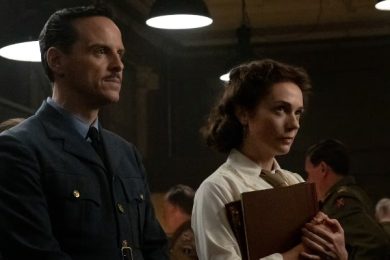









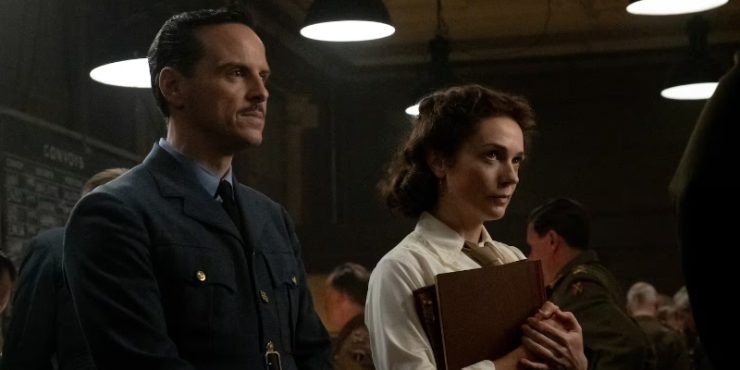
We’ve mined the narrative prospects of World War II so thoroughly that it’s difficult to find any kind of fresh perspective on the matter. This is true in all art forms but particularly in film where we’ve recreated nearly every aspect of this conflict on scales big and small. Pressure is based on a play by David Haig, and follows meteorologist James Stagg who is tasked with forecasting the weather before D-Day. Stagg is played by Andrew Scott, the dependable Irish actor who, in the last five years, has finally been given the chance for lead roles, albeit in smaller films. Scott has proven himself versatile across genres, but Pressure is a much more conventional mode than he’s usually in. There really isn’t any film genre more conventional than the WWII movie, a genre often defined by its strictly binary lines of good and evil. The film’s release coincided with the eightieth anniversary of D-Day, proving yet again that there is always a ready-made audience eager to remember an era when Western empire seemed more noble.
Thanks to a hearty recommendation from prime minister Churchill, Stagg is appointed as Chief Meteorological Officer in the planning of D-Day. He is called over to Allied Headquarters by General Eisenhower himself (played, curiously, by Brendan Fraser), and is tasked with giving a forecast for the D-Day invasion which is scheduled to occur less than three days after his arrival. Eisenhower makes it clear: the importance of this operation is such that Stagg must provide absolute certainty in his conclusion. But Stagg cooly observes that certainty in meteorology does not exist – it’s a point that he must make often throughout the film, but it is seldom comprehended. Stagg must work with fellow meteorologist Irving Krick (Chris Messina), an American known for his work not only with the US military but also in Hollywood. Krick’s process includes researching weather patterns of the past to predict what will occur in the future, where Stagg prefers hard data, claiming that past behavior has no bearing on what will come down the road. This fundamental difference of opinion will be the root of a lot of tension between Stagg and the war machine eager to make landfall in Normandy.
One can see how this story would function well as a play. Most of the story is uniformed men standing and talking at various decibel levels. Director Anthony Maras tries to add vibrancy by mixing in montages of weather balloons and data entry, often supported by a boisterous score from Volker Bertelmann. Maras does a fine enough job, but one feels as you watch that extracting drama here is like drawing blood from a stone. Add to that we already know (one assumes) the outcome to D-Day, we are only left to learn how Stagg influenced them, which we know he did, or else they wouldn’t have made a movie about him. Pressure posits that Eisenhower, Krick, as well as the whole of the Allied military turned the screw on Stagg to undue his integrity. The operation is crucial, and any delay is costly. Why should the opinion of one weatherman undo years of military planning? This the challenge that Maras and Pressure sets up for itself, making that compelling.
Listen, this is a good enough war drama that understands that it sinks or swims on the strength of its performances. Specifically, the performance of Scott, who plays Stagg with a great severity that never spills over into over-serious. In a post-Fleabag era, many may forget that Scott is an actor that flourishes when playing annoying pedants who are, nevertheless, always correct. He stands toe-to-toe with Eisenhower, and doesn’t give in to figures like Krick, or the hawkish British Army General Bernard Montgomery (Damien Lewis, in a performance that could only be described as “out of its fucking mind”). Stagg won’t give these figures the certainty they demand. Even worse, he casts doubts on their hopes for cooperative weather, possibly upending the entire operation. This is a situation where he has to be right, and Stagg knows enough about his job to know that he can’t make estimates with that level of assurance. Scott holds all of that in a performance of measured interiority, which gives Pressure a much needed boost in watchability.
Kerry Condon has a role as Kay Summersby, the private secretary and confidante of Eisenhower. She’s the only person who seems to agree with Stagg despite his unfriendly nature. It’s a thankless part which Condon nevertheless makes into a performance that’s impactful, even if the character isn’t. Fraser as Eisenhower is such a baffling choice that it speaks to a kind of budgetary shortfall. There’s a lot to overcome and the script (written by Haig and Maras), puts a lot on his plate. The performance is mostly fine if you don’t stop to think about how wrong he is in the part, but that’s a difficult fact to sidestep, as the Oscar-winning actor hulks around trying to make up for the fact that there isn’t much resemblance at all. But if you’re watching Pressure, you’re watching for Andrew Scott, and with a running time of an hour and forty minutes, the movie never feels as laborious as it could. It’s a solid piece of professional filmmaking that serves two functions: showcase a talented actor (success) and bolster pride in Western empire (success…?).
.
Directed by Anthony Maras