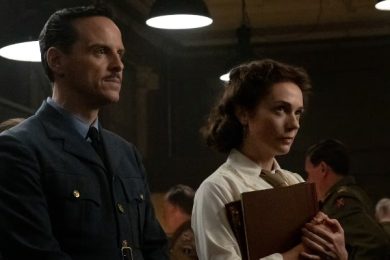

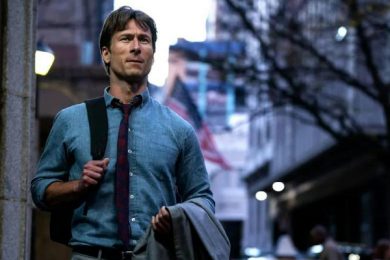


It’s impossible to watch Christopher Nolan’s The Odyssey and not be bowled over by the sheer scope of it. Oppenheimer gave Nolan his deserved Oscar, and it’s accompanied box office success gave him – and his exacting process – the right to any budget that he wanted. He is a filmmaker obsessed with using as little visual effects as he can, working in a Hollywood era where it’s taken for granted that most set pieces will be accomplished with a green screen. That his influence stretches so wide makes him the only candidate to adapt Homer’s epic poem, often credited as the foundational tale of Western literature. There’s an audacity to these projects, a standard set and a challenge answered. With few exceptions, Nolan meets his standard while staying as true to his analog ethos as he can. How does one make The Odyssey into a single, comprehensive feature film? Not only does Nolan pull off that task but he creates yet another cinematic triumph in the process.
Most people have read The Odyssey, usually in school, and even if you haven’t, its episodic tale of Odysseus returning home from his victory following the Trojan War is so ubiquitous within narrative history that it’s hard to be unfamiliar. That familiarity is a challenge in and of itself – and Nolan’s film has already courted the ire of many an internet edgelord (many of whom don’t even plan to watch the movie) exclaiming The Odyssey’s supposed lack of fidelity. The internet’s ability to conjure irrelevant controversy aside, Nolan uses the iconic imagery, and our knowledge of it, in unexpected ways, diverting our expectations while telling us the most recited story in human history. In the first of many bold choices, the film opens with rapper Travis Scott playing a bard who begins to recite the famed songs of Odysseus, expertly tying the oral tradition of Homer’s works to current day songwriting. It’s not the last time that he successfully modernizes this ancient tale.
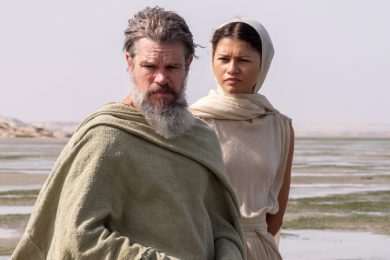
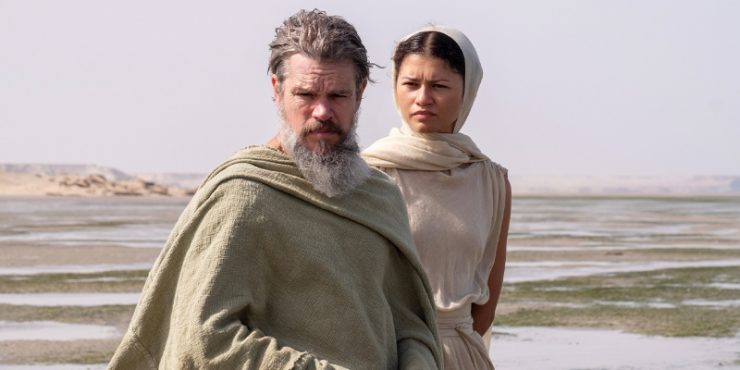
In the role of Odysseus is Matt Damon, an undeniable American movie star who nonetheless is a somewhat atypical choice for this part. Odysseus is a man whose legend stretches credibility even while he’s alive, while Damon is an actor often happy to sacrifice spotlight for the betterment of whichever film he’s participating in. Damon’s Odysseus is world-weary and without vanity, motivated by the guilt of being away from home and shamed by his exploits in the Trojan War. Much like his version of Robert Oppenheimer, Nolan is crafting an epic protagonist whose plagued by introspection, far from the arrogant champion in most translations of Homer’s tale. Damon’s ability to appear grounded is his greatest asset as an actor. He is perhaps the most “approachable” movie star since Tom Hanks, and that colors the Odysseus that we see here who finds himself questioning all the glory that he’s accumulated.
As one expects, Nolan does not outlay the plot in a linear fashion, but all the major points are there: after sacking Troy with the cunning ploy of hiding within the trojan horse, Odysseus and his men begin their journey back to Ithaca, where Odysseus is king and his wife, Penelope (Anne Hathaway), and his son, Telemachus (Tom Holland), eagerly await his return. The trip takes much longer than expected – ten years, in fact – and includes interactions with a giant cyclops (played with remarkable pathos by Bill Irwin), an island of murderous giants, a vengeful Circe (an absolutely incredible Samantha Morton), amongst many other adventures. Back in Ithaca, Telemachus must contend with dozens of unscrupulous suitors who believe Odysseus dead and demand their opportunity to marry Penelope. Chief among them is Antinous (Robert Pattinson), a sniveling schemer who once knew Odysseus before the war.
Nolan doesn’t skimp on any of the iconic imagery one would expect from an Odyssey movie. The Trojan Horse is erected in all of its glory, even if it does question that glory outright. He intelligently keeps the involvement of the Gods obscured. The only explicit presence is that of Athena (portrayed by Zendaya), but even that gets subverted in a way I won’t spoil here. Odysseus loses many men on this trip back home, and many of them, especially his embattled second-in-command Eurylochus (Himesh Patel), begin to question his leadership, and wonder allowed if they are cursed by the Gods. By withholding the images of, say, Zeus or Poseidon, Nolan once again gives this tale a sense of earth-bound authenticity, without sacrificing the magic in the story. Many of characters find themselves bound by “Zeus’s Law”, an ethos that, most simply, compels compassion and hospitality on those less fortunate. But we find how often the men of this world – even Odysseus – pervert this law to suit their own agendas, yet another call toward current-day corruption that Nolan weaves into the screenplay.
And that’s why, for all that can be said of the visual wonder of this film, which is plentiful, I found myself most impressed by Nolan as a screenwriter, in how he works around the criss-crossing story elements while also adjusting the expansive tale to fit inside a single movie. It’s a near-impossible assignment, and Nolan cracks it so effectively, bridging this ancient tale to our contemporary times without being didactic and without sacrificing the texture and detail of the setting. Trickery has always been a part of Nolan’s storytelling style, and The Odyssey still indulges his penchant for overlapping storylines and mystery box framing, but this is one of the more straightforward screenplays that he’s ever written. In keeping the motif, a lot of scenes are told in recollection, whether that be the vantage point of Antinous or Sparta King Menelaus (Jon Bernthal). The main frame of the film is Odysseus struggling to remember the tribulations of his journey as he lives with the island nymph, Calypso (Charlize Theron).
The impossibly good cast also includes John Leguizamo as Eumaeus, a blind servant of Odysseus who now advises Telemachus, Lupita Nyong’o as Helen of Troy, a trophy of the Trojan War bestowed on Menelaus, Corey Hawkins as Polybus, a cruel suitor and co-conspirator with Antinous, and Eliot Page as Sinon, a servant boy of Antinous sent into war who ends up having a major emotional impact on Odysseus. This doesn’t even mention the ensemble of bit parts all played by recognizable faces and names, adding gravitas to the film without distraction. Above them all is Damon’s Odysseus, in a performance of tremendous measure and appropriate vascularity, that perfectly demonstrates Nolan’s contemplative take on the character. Damon refuses any demonstrative outburst, or really any acting that would call attention to itself. It’s an egoless decision that plays beautifully in the movie, and illustrates why he may be the most underappreciated star of his generation.
The rollicking nature of the film’s action (supported by a punishing sound mix which plays at a volume that drops you directly into the chaos) can sometimes distract from the resolute tidiness of the writing, which balances everything and everyone with expert precision. I’ll admit while watching this for the first time, I spent a majority of the near-three hour run time quite impressed by the sheer scale of everything involved in the filmmaking and the performances. (This is as good a place as any to say that the genius of cinematographer Hoyte von Hoytema, editor Jennifer Lame, and composer Ludwig Goransson are on further display here.) But it wasn’t until I got to the film’s elegiac third act, where Nolan pulls a stunning reversal of legend and harnesses this epic tale into a personal exploration of accountability and self-mythologizing. It’s a screenwriting gambit that, as you’re watching it, doesn’t feel like it should work. Not only does it work, but it hits with such powerful emotional effectiveness, it reorients everything that came before it. It’s a conclusion that really makes you want to watch the movie again, which is the calling card of any truly good movie.
.
Written for the Screen and Directed by Christopher Nolan