




Films have been made about inter-generational conflict approaching art and authenticity but I don’t know if any of them have done so with such clarity and delicacy as Kent Jones’s Late Fame. The movie speaks to how powerfully seductive recognition could be, while plainly stating the empty calories that it provides. The script is written by Samy Burch, the author behind Todd Haynes’s 2023 film May December, one the best films of this decade. May December and Late Fame are two very different films in both aesthetic and tone, but both screenplays detail the toll that notoriety can bring, even while showcasing how alluring it can be. This is only the second narrative feature from director Jones, after 2019’s excellent Diane, and the film critic-turned-filmmaker, has shown himself to be a crafter of sensitively told character pieces that deceive you with their quotidian observations and mild atmospheres before bowling you over with unexpected emotion.
Willem Dafoe plays Ed Saxberger, a postal worker living in the Lower East Side of Manhattan. He makes regular visits to the local bar to hang out with his friend, Arnold (Clark Johnson), among several other patrons, but otherwise he lives a life of solitude, making tuna sandwiches while avoiding phone calls from family members. One day a young man is standing outside of his apartment building, waiting to talk to him. Meyers (Edmund Donovan) explains that he’s read Ed’s book of poetry from 1979, Way Past Go, and he thinks it’s an unsung masterpiece. When Meyers learned that this great unknown poet was living in New York City, he decided that he had to pay him a visit and give the artist the kudos he deserved. Baffled but flattered, Ed thanks the young man before going along with his day. When Ed runs into Meyers again, he decides to join the young man in a local café where Meyers and a group of young, serious art appreciators congregate.
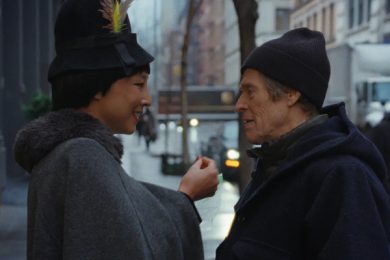
The group calls themselves “The Enthusiasm Society”, and it includes a maraud of writers and actors including the neurotic performer, Carmichael (Arthur Langlie), the disgruntled essayist, Brussard (Clay Singer), and the sensitive, very young Winn (Luca Padovan), among others. Meyers introduces Ed to the group as “Saxberger”, as it becomes clear that Meyers’s opinion – that Ed is a brilliant artist ripe for rediscovery – is the prevailing wisdom amongst the crowd; though enthusiasm at his presence varies. This collection of eccentric, exceedingly pretentious young white men leaves Ed nonplussed, but upon the arrival of Gloria (Greta Lee), Ed becomes more interested. Gloria is an actress who holds the group under a spell of beauty and glamor, speaking an affected Mid-Atlantic accent, and giving each group member just enough flirty attention that she becomes the unofficial heroine of them all.
Gloria is effusive in her praise of Ed’s work, much like everyone else. Meyers and crew convince Ed to produce new poetry for a live event that they’re organizing, and Gloria decides that she wants to be the one who reads it. Ed, who hasn’t participated in the New York bohemian community in decades, finds himself off balance with this sudden adoration, and against his better judgment, he agrees to write some new material for the event. He begins to visit the café more regularly than he does his usual bar with Arthur, and as that once lost sense of himself as an artist grows, the more his own working-class lifestyle loses appeal. Certain details about the group begin to arise. They are financed entirely by Meyers’s generational wealth, and are obsessed with obtaining artistic immortality without having any knowledge of how to create actual art. This is easy enough for Ed to ignore, as long as the devotion continues to flood in.
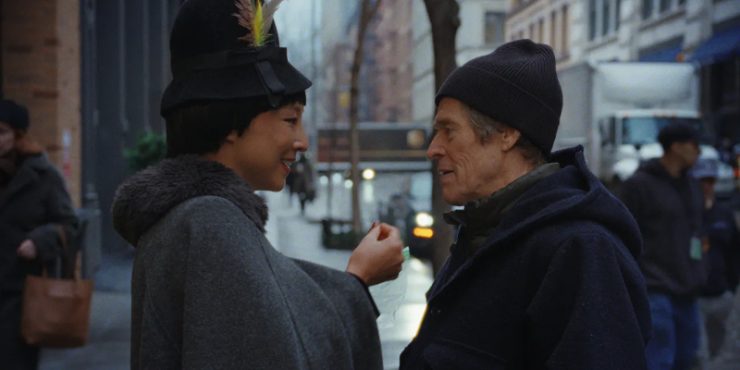
More than anything, Ed finds himself bewitched by Gloria. By her beauty but also by her otherworldly persona, the perpetual performance that seems to run effortlessly through her life. Gloria is a bit older than the rest of the Enthusiasm Society, and even though she’s by far the most performative, Ed connects most with her, her dramatics a sheer veil over a desperation. The Society is filled with rich boys looking for a short cut, Gloria may be the only one in the group who is as economically undistinguished as he is. It’s with Gloria that Ed most enthusiastically shares details of his former life, the famous literary artists he had the pleasure of meeting and knowing. This former life is so removed from his current reality, and it’s difficult for him to truly understand the grand reverence that the young men have for it. New York City has transformed around him, but he has changed as well. This sudden confrontation with what his life could have been if he’d had the career of an Allen Ginsburg or a Cookie Mueller stirs up complex emotions.
The truth is that Ed was a man who surrounded himself by art, but never stopped to consider himself an artist, at least not by the standards of those he most admired. Way Past Go is less a spilling of the soul than an expulsion of thought. “Poetry was in the air,” Ed explains to them. It’s something akin to breathing, and little more profound than that. As Ed learns what it really means to find notoriety, however small, he begins to see how it affects how people treat him. The motives of Meyers and the Society at times feel questionable, their end game hard to fathom. With sudden notice comes insecurity, Ed feels for the first time in decades the need to prove his talent, a talent he never even considered for most of his life. Ed had found something close to peace in his life, though his refusal to acknowledge his family’s phone calls suggests an unease. Could this attention begin a new chapter in this otherwise ordinary life?
Dafoe, a truly great and versatile actor, is capable of incredible sensitivity. His severe features often lead him to play menacing villains. Less often is he playing this low to the ground, and it’s all the more special when it happens. He plays Ed as a man suddenly trying to catch up on nearly forty years of New York City art life. He’s naïve about what Meyers can truly offer him, while also more clear-eyed about the realities of literature than these young men will ever be. Greta Lee, herself a remarkable performer, has lately proven herself across multiple genres. She is Late Fame’s biggest question mark, both for the audience and the characters in the film. Gloria’s larger-than-life presentation is obviously hiding something. This is not a film with a great amount of plot, and the true nature of Gloria, how she finances and creates that lifestyle, is the movie’s biggest cliffhanger, and Lee delivers that reveal with powerful pathos. In the end, we learn Ed and Gloria are enriching themselves on the attention of these young men, which is unsustainable.
Burch’s screenplay is based on a novella by Austrian author Arthur Schnitzler which was published in the late nineteenth century. It’s difficult to see how a minor work by a pre-War Viennese dramatist could translate so well to 2026, but Burch and Jones find a fascinating path between the two. The emotions dissected in Late Fame can be tracked across human history, and speaks to that fundamental need to be loved, and even more fundamentally, be understood. The film is much more granular in its approach though, and Ed proves to be a compelling character in his plainness. Against the gentle rhythms of his everyday life, the concept of artistic genius becomes something like an encroachment for him, but there is still an undeniable appeal. It’s a fascinating paradox that Jones acutely studies even though clear answers are nowhere to be found. What is found is a delightful little movie that I hope reaches a much wider audience than it has so far.
.
Directed by Kent Jones