


Like most notable writers, Martin McDonagh has his array of preferred tropes. Harsh language and bleak themes balanced by biting humor and rat-a-tat repartee. His two most successful films, his 2008 debut In Bruges and 2022’s The Banshees of Inisherin, feature Colin Farrell and Brendan Gleeson as two close friends who come to a violent impasse. McDonagh’s latest, Wild Horse Nine, has a similar set-up, except now the two friends are played by American actors, John Malkovich and Sam Rockwell. The backdrop is 1973 and the setting is Easter Island. This allows McDonagh, along with cinematographer Ben Davis, to capture some gorgeous vistas of the legendary locale, including the daunting mo’ai statues. McDonagh’s development as a visual filmmaker is often unremarked upon – his films have only gotten lusher and more confidently composed with each film – but that might be because the filmmaker himself seems preoccupied only with his own flourishes as a writer, in which Wild Horse Nine includes several.
McDonagh was a playwright of significant renown before becoming a director, so it makes sense that he will always behave (and be seen) as a writer first. All his films juggle provocative, often times controversial, themes and there are times – like with his films Seven Psychopaths and Three Billboards Outside Ebbing, Missouri – when the overcomplication of plot and the cutesy use of elevated drama feels glib when discussing such serious subject matter. There are many who still can’t forgive Three Billboards and its heightened representation of American racism and police violence, and many said that McDonagh’s Irish gallows humor revealed his own racial biases. That’s a very uncharitable view of (what I think is) a very good movie, but one can’t deny that McDonagh’s style leaves him open to that kind of criticism. Which is probably why his scripts often work best when filtered through the fraught relationship of two cranky white men with a penchant for being politically incorrect.
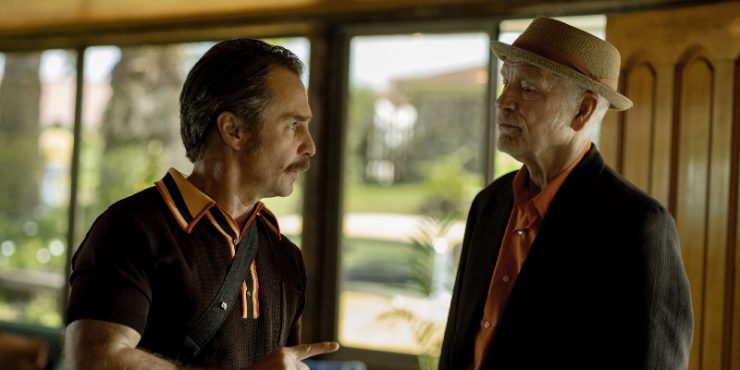
That’s certainly the two leads of Wild Horse Nine. Malkovich plays Chris, a veteran of the CIA currently stationed in Santiago, Chile right after the nation’s first democratic election, which produced the socialist president Salvador Allende. Malkovich’s specialty appears to be toppling foreign governments, replacing elected left-wing officials with US-backed military dictatorships. In the film’s opening shot, Malkovich details his participation in the 1954 coup d’etat in Guatemala, the 1960 assassination of Congolese prime minister Patrice Lumumba, and the unsuccessful Cuban Bay of Pigs invasion campaign in 1961. His most impressive act of political insurgency is the one he’s least allowed to talk about: the assassination of John F. Kennedy in Dallas in 1963. This is just like a McDonagh script to introduce a character, plow you with the details of his atrocious behavior, and then dare you to spend an entire movie with him. We’re not the only ones. Close friend and fellow CIA spook, Lee (Rockwell), is also tasked with spending time with him on a short vacation with a very morbid itinerary.
Chris is dying very rapidly from unspecified cancer, and he asks his friend Lee to travel with him to Easter Island to help end his life on his own terms. Chris’s desire to be killed by his friend fits conveniently with the plans of MJ (a hilarious Steve Buscemi), the Head of the CIA’s South American operations. Chris’s advanced illness, coupled with a substantial morphine addiction, and piled atop his general state of obnoxious outspokenness, makes him a very dangerous liability for the CIA, and MJ would appreciate if Lee would dispatch of that liability, especially since it appears to be in Chris’s own interest anyway. Lee finds himself incredibly torn. He can’t speak to his friend’s state of mind, nor does he approve of the substance of his boss’s request. Lee is stuck in an unenviable bind. On one end he must curtail Chris who seems on a mission to reveal to the blissfully unaware Chilean citizens about their oncoming dictatorship. On the other, he must fight off MJ who continues to put the squeeze on him.
All the while, Chris gets the idea to write a memoir, and spends a good amount of the film dictating into a miniature voice recorder, spouting random bits of nonsense that are occasionally punctuated by the cold hard facts of his violent past. There is the occasional reflective aside, the hint of regret. A Catholic, he seems unsettled about the afterlife. Does a man who’s murdered dozens of people make it to heaven? All his thoughts are a muddle due to the cancer and the morphine, and his conversations with Lee have a frustrating, cyclical quality to them. Despite it all, Chris still does manage to charm here and there. A young student and idealist, Monica (Mariana di Girolamo), gives him the time of day despite his frank skepticism of President Allende. His general incoherence and obvious melancholy buys him some sympathy from those around him, especially Lee, but Chris is clear-eyed about at least one thing: he’s dying very soon and he’d like to orchestrate how it happens.
The first two-thirds of Wild Horse Nine are extremely enamored with its leads and the clumsy way they interact with their foreign locale. The script mines the contrast between their quotidian conversations and the high political stakes of their work for comedy. These are extremely violent men having conversations about how good cheeses come from homosexual countries and whether dinosaurs made it into heaven. How the movie feels about Chris’s career achievements is kept close to vest. Not much time is spent pondering the innocent lives lost in Guatemala or the Congo, and there’s even humor derived from the dramatic irony in the eventual fate of Chile, which is soon to face the brutal oppression of the Pinochet regime. I don’t need McDonagh to explain to me that Chris and Lee are bad guys. That much is self-evident. But there’s not much that’s very interesting in their repetitive conversations or their theoretical repentance. Malkovich and Rockwell are two great actors giving two good performances, but these are the thinnest characters that McDonagh has possibly ever written.
This lack of specificity in these people is pretty relevant considering what the film is asking us to think about them, and you wonder if McDonagh put in the same level of thought in creating them as he has with previous anti-heroes that he’s penned. Whatever profundity one is to deduce from Wild Horse Nine feels minor since the film has almost no consideration for all the murder Chris, Lee, and the CIA at large, are responsible for. I must admit, a lot of this gets cleaned up in the film’s final act which is very successful dramatically, thanks in large part to a handful of spectacular Malkovich scenes. McDonagh’s screenplay waits until the final thirty minutes to draw a line in the sand, and one understands why: it allows Chris, and Malkovich’s performance of him, to really surprise you in ways you’d least expect. But it still leaves me with the film’s previous seventy-five minutes which are mired in tedium of dubious moral standing. The film’s redemption is shabby as a result, even if the film’s conclusion is undeniably satisfying.
Malkovich and crew are wonderful to watch, and McDonagh has once again proven himself to be an innate talent in crafting performance. Despite all the backlash, Three Billboards did still manage to win acting Oscars for Rockwell and Frances McDormand, and Colin Farrell certainly should have won the acting Oscar for The Banshees of Inisherin. Malkovich seems primed for a nomination and a possible win, and if Wild Horse Nine is being measured in its award season tally, I have no doubt it will prove successful. McDonagh may even get rewarded for his screenplay, despite it being the weakest of his career. It is hard to write these kind of characters, and even when it’s done well, it can get misconstrued by an inattentive audience. Just ask McDonagh himself about that. But it seems the task proves too difficult for McDonagh here, and a majority of his script is filled with his two leads repeating the same out-of-pocket lines back to one another in an attempt at absurdity. But Wild Horse Nine is not actually absurd, but actually very sobering – you’ll wonder often if McDonagh realizes that.
.
Written and Directed by Martin McDonagh