

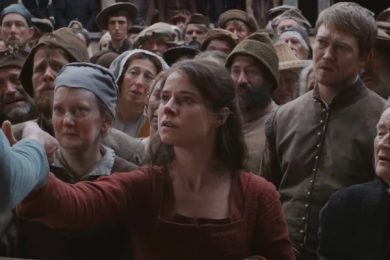
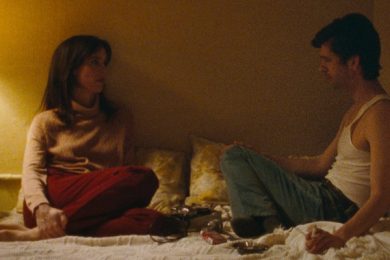
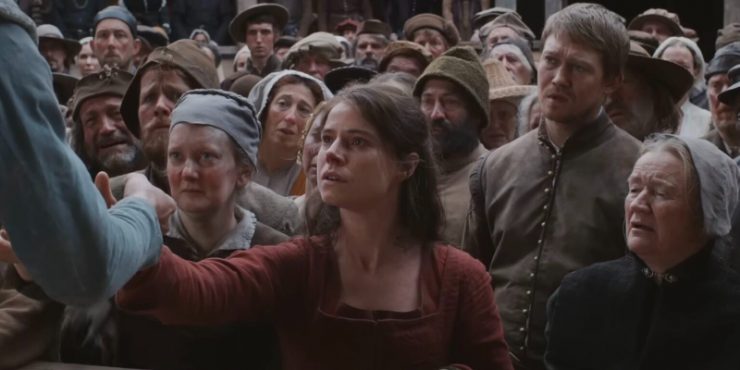
There are three scenes of babies being born over the course of Hamnet, and not a single umbilical cord to be seen. Chloe Zhao is too detail-oriented a filmmaker for this to be an oversight. It’s one of Zhao’s many motions toward the film’s emotional supremacy. The film’s characters – which include William Shakespeare – are not motivated by logic. They won’t allow their lives to be dictated by the pragmatic. Hamnet is an adaptation from the very popular novel by Maggie O’Farrell, a work of fiction that speculates on some particular facts in Shakespeare’s life. Namely, that the renowned playwright and poet had a son named Hamnet who died as a child from the plague. Afterward, the Bard went on to pen what is arguably his most famous and most lauded work, Hamlet. These facts seem inextricable from one another despite no actual evidence of a connection, except the name. A note at the start of the film states that the names “Hamlet” and “Hamnet” were considered interchangeable at the time – so how, if at all, were this death and this play connected?
We don’t actually know and O’Farrell is pretty transparent about that. Her book takes the point of view of Hamnet’s mother, Agnes (an alternate, but documented, name that was used for Shakespeare’s wife, Anne Hathaway), a savvy choice which allowed the author more free reign in creating this historical fiction. Agnes is a willful, unrestrained woman whose mother taught her many ways to use the natural world for healing and premonition. In the film, she is played by the Irish actress, Jessie Buckley, who in just a few years has made a strong career, playing willful, unrestrained women. Buckley’s performance, the heavy favorite for the Best Actress Oscar this upcoming Sunday, is a powerhouse. A tempest (sorry) of unpredictable volatility and vulnerability. It is a heavy responsibility that Buckley takes on, externalizing and, in many ways, literal-izing the ethereal themes that Zhao explores throughout Hamnet.
Agnes falls in love with a Latin tutor (Paul Mescal), the sensitive son of an abusive glover, John (David Wilmot). John is renting his son’s teaching abilities to pay off his copious debts, one of many reasons why this young man’s pursuit of Agnes is fraught with trouble. Like the book, the film makes very little effort to reveal that this tutor is William Shakespeare (he’s referred to by name only once in the whole film), which further emphasizes Agnes’s point-of-view. When Agnes and William decide to get pregnant to force both sides of the family to accept their marriage, there’s some consternation from her brother Bartholomew (Joe Alwyn), and outright fury from his mother, Mary (a fantastic Emily Watson). Upon giving birth, Agnes flees into the woods alone, and their first daughter, Susanna, is born within the crevasse of a great tree, further cementing Agnes’s spiritual connection to the natural world around her.
When William begins working in London, gloving for a theater troupe, Agnes stays with Mary in the tense Shakespeare home. William’s life becomes further and further drawn into the city while Agnes becomes further cemented in the country. She gives birth to twins, but a big storm prevents her from making her trek into the woods. Mary and a midwife force her to give birth at home, where Judith and Hamnet are born. Agnes’s premonition of having two children is thrown off its axis when she gets two more children instead of one. As Judith and Hamnet grow older, she becomes obsessed with protecting them from whatever tragedy may befall them. As I’m sure you already know before the film begins, tragedy does befall them as the plague comes upon their home and takes the titular son who thereafter becomes immortalized in theater.
O’Farrell wrote the screenplay adaptation with Zhao, and one of the major changes they make is forcing the story into a strict linear progression. This means that the main tragedy at the center of the story ends up occurring somewhere around the halfway point. The film’s first half builds the context that leads to Hamnet’s death and the second half examines the aftermath of two parents who struggle with grief in incredibly different ways. Another venture from the book, Zhao’s film puts a much larger emphasis on the point-of-view of William, as the script tries to further explain how the death of a son could then influence the creation of the most famous play ever written. The impact of a movie like Hamnet – which is, first and foremost, attempting to be an emotional film-watching experience – relies heavily on your ability to buy into O’Farrell’s fictional premise that one would lead to the other.
I struggled buying into this during the novel, and Zhao’s expanded reasoning does very little to help assuage that. It requires you too discard too much about what we do know about the play of Hamlet, and the substance of its characters. It reduces that play’s complexities in an attempt to heighten the complexities of its own characters, but the execution isn’t thorough enough to work as anything more meaningful than a tear-jerker. The performances of Buckley and Mescal, so attuned in their intensity, are good, and the holistic approaches that Zhao is prone to take as a director does a lot to ground Hamnet in a necessary earthiness. It’s a film that has an incredible sense of place, if not a sense of meaning. I don’t envy the screenplay’s task. Trying to find an original, expressive way to depict grief is noble, but Hamnet’s methods feel agonized, too tempered by its relation to a work that is all too familiar.
Perhaps I also envy those willing to look past this script’s shortcomings to feel everything that this movie wants you to feel. The ways in which Hamnet reaches for the audience’s heartstrings would feel more shameless if in the hands of a less talented director. Zhao won the Oscar for Nomadland, but before that struck a perfect chord with The Rider, a movie that fused fiction and nonfiction filmmaking into a sublimely heartbreaking story. That kind of street level style is probably gone in the post-Eternals era of Zhao’s career. Hamnet does feel like an attempt to reclaim the more humble aesthetic of her filmmaking style, and certainly doesn’t have the resources of a Marvel movie. Instead, Hamnet works somewhere in between, closer to Zhao’s more independent roots but not quite there. She still manages to get some great performances from her two leads (and another great performance from the great Emily Watson), which are about as undeniable as the film gets. But if you’re the Big Emotional Movie and the Big Emotional Moment doesn’t register, then there’s a problem.
.
Directed by Chloe Zhao