








The films of director Kleber Mendonça Filho are fascinating crosses between the cerebral and the spectacle. There’s a bold, unapologetic political streak that runs through his screenplays, and his public appearances reinforce his anti-authoritarian views. His 2016 film Aquarius was a screed against gentrification perfectly packaged as a layered character study (with an other-worldly performance by Sonia Braga). Then in 2020, he made Bacurau, a violent, surrealist take on the inherently bizarre happenings within a village overtaken by corruption. Those two films could not be more different stylistically, even as they both document the danger of having working class solidarity within a political system that is increasingly hostile to it. His latest film, The Secret Agent, is perhaps his most successful American crossover, with four Academy Award nominations, including Best Picture. It’s difficult to imagine a filmmaker as uncompromising as Mendonça Filho receiving such mainstream accolades, and it’s heartening to finally watch the film and learn it required no sacrifice of his intellectual rigor.
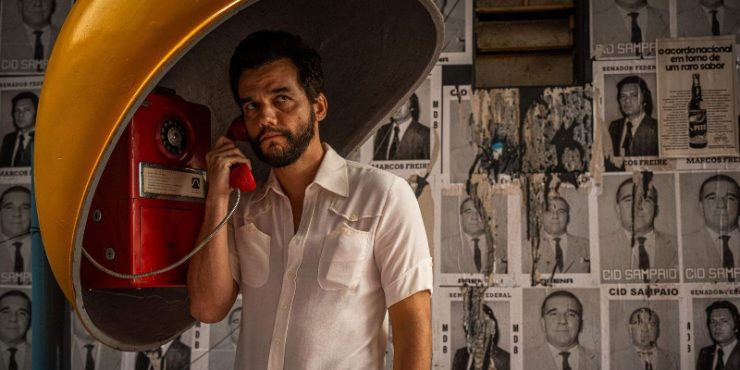
The setting of The Secret Agent is similar to a Best Picture nominee from last year, Walter Salles’s I’m Still Here, which also took place during the Brazilian military dictatorship of the 1970s. I’m Still Here was a story of government intimidation putting work against an unbreakable spirit, and it gave actress Fernanda Torres a chance to play a character of real triumph. Salles was making a movie that touted the perseverance of the oppressed to survive forces of evil. Mendonça Filho is a bit more ambivalent in his assessments. His film stars Wagner Moura as a stoic man named Armando (or Marcelo, a name he takes on for most of the film), a former university researcher forced to live in hiding after offending a mid-level businessman with high connections. The details of Marcelo’s “offense” come slowly and over time, as do the details of his personal life, including a young son, Fernando (Enzo Nunes), whom he lives apart from, and a deceased wife, Fatima (Alice Carvalho). Fernando lives in Recife with Fatima’s parents, and early in the film Marcelo states his first of several goals: getting his son and fleeing persecution.
The Secret Agent plays in the tradition of other paranoia political thrillers of the 1970s (think The Parallax View or Three Days of the Condor), and Mendonça Filho uses intrigue to build mystery around Marcelo’s maneuverings through layers of deception. When he gets to Recife, he’s greeted by Dona Sebastiana (an incredible Tania Maria), the elderly matriarch who oversees a building of political dissidents and other wayward figures. She gives an open room to Marcelo and helps facilitate a position for him in the identification offices, where Marcelo hopes to find proof of his mother’s existence. Her disappearance is yet another allusive strand within the narrative where information is sparse, but provides further color of a regime that often weaponizes their ability to makes people disappear. As the details of Marcelo’s past and present form, we also learn about the corrupt police chief Euclides (Roberio Diogenes), who’s loose but violent grip on the city is aided by his sons. Marcelo becomes friendly with Euclides, but it’s unclear as to how much that helps his cause.
When the hitman Augusto Borba (Roney Villela) and his stepson Bobbi (Gabriel Leone) accept a contract on Marcelo from a business administrator (Luciano Chirolli), we start to understand the stakes, but Mendonça Filho expertly lures you into this plot by withholding, constantly making the audience play the detective that the film itself lacks. The result is a thrilling viewing experience where the twist is that Marcelo’s life is not nearly as cloak and dagger as it may appear. The “secret agent” of this film is not a noirish figure playing subterfuge for personal or political gain, but an everyday man forced into a double life after he and his wife made the mistake of angering the wrong authority figure. With each new detail, the depravity of the ruling class takes full form, while the desperation of the persecuted becomes clearer and clearer. Using dark and eccentric humor, Mendonça Filho throws you off the scent of the film’s bleaker themes, but as they reveal themselves, it’s quite a chilling experience.
This is punctuated by an ending that completely recontextualizes everything that came before it. The drama, we learn, is actually a red herring. The reality is much more sobering. The details of the film’s finale shouldn’t be spoiled here, but it’s sufficient to say that its unexpected effects redefine not only Mendonça Filho’s screenplay, but also the performance from Moura, which is exquisitely understated throughout. Wagner’s soft touch will keep you hooked, carefully guiding an audience that may feel alienated by Mendonça Filho’s aesthetic disciplines. It’s not merely that the Brazilian actor gives you someone to root for, but he gives the sprawling Secret Agent a much-needed foundation, a surrogate who pays proper credence to the absurdity that swirls around him. Wagner is surrounded by an array of veteran actors (Udo Kier’s final film role is a poignant one as a German expatriate oft mocked by Euclides) and non-professionals who provide authenticity to the film’s setting. It makes sense that The Secret Agent is amongst the nominees in the Oscars’ first ever Best Casting category.
We’re introduced early in the film to a severed leg found within the body of a local shark. The leg goes on to become a character of sorts in the film, used by local media as a human interest story that in fact distracts citizens from the actual violence being committed by corrupt officials. The atmosphere of 1970s Recife, equal parts hedonistic and draconian, is perfectly encapsulated by “The Hairy Leg”, who gives many an outlet to explain away the day-to-day horror of reality. It’s yet another ingenious creation by Mendonça Filho who litters The Secret Agent with such evocative (and provocative) imagery that enchants the mind while slipping in more frightening truths. The awards success of The Secret Agent probably owes a lot to I’m Still Here’s success the year before, but this year’s film is a much more biting, uncompromising story. It’s not looking to inspire emotion, but thought, and it does so in a wholly unique way.
.
Written and Directed by Kleber Mendonça Filho