









Ever since his debut film, Reprise, in 2006, Norwegian director Joachim Trier has always had an interest in fusing the literary and the cinematic. He and his writing partner, Eskil Vogt, often utilize framing devices to give their scripts the feeling of a novel, whether that be chapter titles or an omniscient narrator, sometimes both. Reprise was a movie about novelists, so the conceit was especially astute, but since then Trier has utilized a similar style to less literary-oriented stories. I may be the only person who truly loved his 2015 film Louder Than Bombs; his only English-language film that explored the Faulkner-esque foibles of a troubled, fracturing family in the midst of tragedy. His latest film, Sentimental Value, is another film about a family. They’re tinged with trauma even if it’s not the screenplay’s main focus.
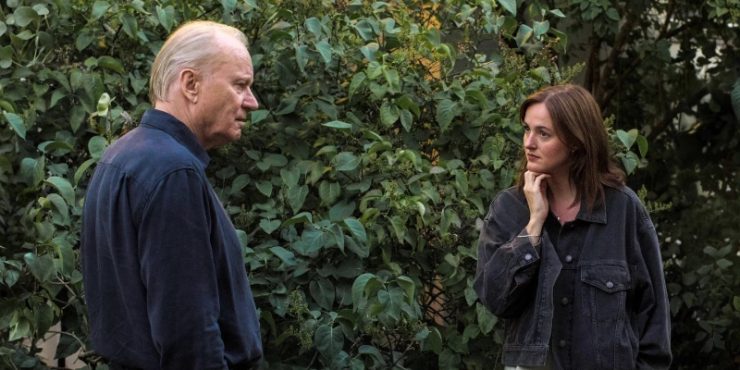
Sentimental Value stars Renate Reinsve, the Norwegian actress who’s incredible performance in Trier’s 2021 film The Worst Person in the World not only launched her career but elevated Trier from a beloved independent filmmaker to a director with crossover appeal. Trier and Vogt got an Oscar nomination for Worst Person’s screenplay. Reinsve’s performance in that film gave the oft-morose Trier a much-needed infusion of humor and unpredictability. Sentimental Value is more in Trier’s usual wheelhouse: melancholy and conversational, flourishes of cinematic style contrasting the somber tone of the characters. Reinsve plays Nora Borg, an actress with severe stage fright. Her estranged father, Gustav Borg (Stellan Skarsgaard), is a beloved international film director. Gustav’s inability to understand his tempestuous daughter has created an eternal hostility, and Trier’s script tracks the ripples of family history that have brought us to this moment.
In his 70s, Gustav has not made a film in over a decade, and he has been basking in his emeritus years, attending tribute screenings and receiving lifetime achievement awards for his past glories. When Nora’s mother (and Gustav’s ex-wife) passes away, he makes a surprising appearance at her wake. Nora is upset by his very presence, but she’s even more upset when she learns that the family home that their mother had resided in for decades after the disastrous divorce is now officially in Gustav’s name. Nora learns this from her sister, Agnes (Inga Ibsdotter Lilleaas), the other daughter from the doomed marriage. Agnes isn’t as embittered by her childhood experiences. As a child, she had a starring role in one of Gustav’s most enduring films; and even now she still works with her father as a researcher on his screenplays. A wife and mother herself, Agnes is often forced to be the reasonable intermediary between her warring family members.
Gustav’s latest screenplay is his first in many years. His manager claims it may be his best yet, a direct confrontation to all the themes he’s addressed across his career. He surprises Nora by asking her to play the lead role. Nora scoffs at the request – her father has never sat through any of her plays, so what judge is he of her acting? She turns him down flat without even reading the supposedly great script. Gustav’s fortune takes a turn when a tribute screening catches the eye of American film star Rachel Kemp (Elle Fanning). Rachel stars in broad, commercial films that have gained her fame but little prestige, and she orchestrates a dinner with the aging filmmaker in a ploy to work with him. It’s a mutually beneficial arrangement that leads to Gustav casting Rachel in the part intended for Nora, and bringing the movie star to the Norwegian house that holds decades of love and trauma. As Nora and Agnes navigate their father’s latest encroachment on their lives, Gustav makes more clumsy attempts to reconcile with Nora, with disappointing results.
Trier and Vogt once again use an omniscient narrator to help guide the viewer through the Borg family saga, which is rife with mental illness, infidelity, and political turmoil. The voiceover is less present than in Reprise or Worst Person, since it is mostly a device for exposition, a screenwriting conceit looking to court artistic merit. It’s telling that the film abandons it pretty quickly once it’s served its narrative purpose, betraying that its inclusion is more an allusion to Trier and Vogt’s previous scripts than it is an effective device. This feels representative of all that falls short in Sentimental Value, a movie that dines out on Trier’s earlier, better films (especially The Worst Person in the World) without producing effective feeling in and of itself. This is a well-acted and well-directed film, but to what end? There’s an intense emotional response this family drama requires you to have, but if you’re unable to fill in the gaps that the script leaves, that response will never occur.
A lot is put on the film’s actors, who are led to mostly play the subtext of a scene, which is all fine and good except that Sentimental Value’s script depends on very pat observations on generational trauma and neglectful parenting. We’re given the bare facts of the family, but it’s mostly up to us to create the monstrous Gustav that Nora sees. The Gustav we meet is grotesquely egotistical and flippantly misogynistic. A scene where he gives his grandson a highly inappropriate birthday gift is played for a laugh except that laugh requires us to see him as a deeply unserious person – or worse, deeply irresponsible – which is not how he comes across. Skarsgaard is one of the great scoundrels the movies have ever seen, but that experience means he knows how to make Gustav palatable. Perhaps he’s too good at it, because Nora’s visceral hatred feels difficult to parse.
The answer to this is, of course, that Nora and Gustav are much more similar than either would like to admit. Gustav writing the script with Nora in mind is an almost unconscious recognition of that, though neither party seems to be able to acknowledge it. Reinsve is given the unenviable task of playing Nora, a woman plagued by neurosis that stretches over every aspect of her life. She’s having an affair with her married co-star (played by another Trier regular Anders Danielsson Lie), yet another emotional entanglement that fails to fulfill her. Reinsve has proven to be an excellent acting talent, and her work here is quite good, even if the film’s screenplay leaves her little to really chew on. It doesn’t even tap into her incredible humor, which Trier did so well in Worst Person. (May I also recommend her performance in last year’s A Different Man, one of the funniest performances of that year.)
That Sentimental Value was such a sensation at last year’s Cannes Film Festival (won the Grand Jury Prize) and appears primed to be Trier’s biggest Oscar success yet says much more about the goodwill he and Reinsve created with The Worst Person in the World than the actual quality of Sentimental Value. Throughout his filmography, I’ve always found Trier’s insights into the human condition to be very precise. He inherits the Scandinavian tradition of Bergman while still maintaining his own, more modern individuality. But that precision is missing here, replaced instead with generic observations on the nature of family and the industry of art. Trier’s talent with actors carries a lot of water, and protects Sentimental Value from failing completely, but it’s exactly because we know the lengths of Trier’s (and Vogt’s) talent that we must not forgive this film for trying to short cut its way toward profundity.
.
Directed by Joachim Trier