



Part of what makes Steven Soderbergh amongst the best filmmakers of his generation, is the enigmatic nature of his career arc. As an artist, he’s defined himself by being undefinable. He is at times the most experimental filmmaker of the Video Generation, and at other times (and this I believe I can say without too much pushback) he’s proven to be the most successful commercial filmmaker of the bunch. He balances art and commerce, prestige and blockbuster. He does one for them and one for himself, sure, but even the ones for them always feel marked by individuality. He’s incapable of making an uninteresting film, but since his “retirement” in 2013, he’s become a director who’s made sport of his efficiency, shooting features in record time and editing them even faster. This filmmaking-as-endurance testing has produced some fantastic movies (No Sudden Move, Black Bag), but they’re marked by the supposed effortlessness that was put into them, for better and for worse.
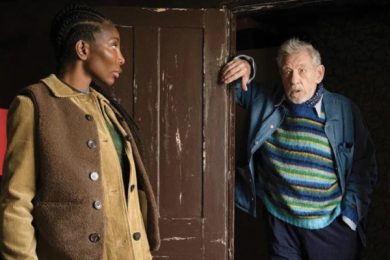
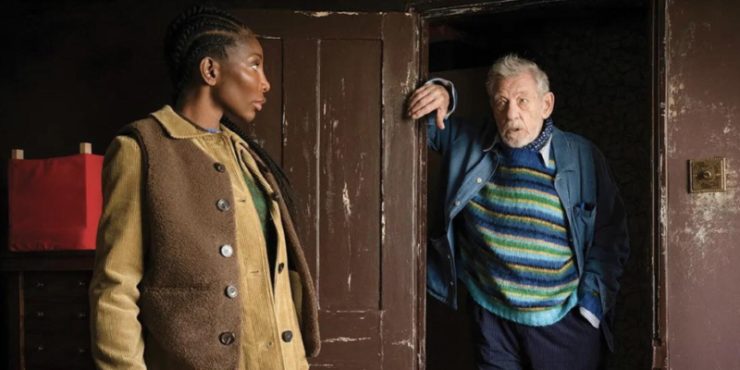
The Christophers, Soderbergh’s latest film, has a similar vibe. The script is by Ed Solomon, who wrote No Sudden Move as well as the Soderbergh miniseries Full Circle. Both of those previous scripts were plotty and heavy with thematic gravitas. The Christophers has a lighter touch, is more dialogue-heavy, and while it’s formlessness plays perfectly into Soderbergh’s line-em-up-shoot-em-down process, there’s a playfulness that requires some more attention – both for the filmmaker and the audience – to really execute properly. The film is a two-hander between veteran English actor Ian McKellen and Michaela Coel, a fellow Englishwoman who’s shown incredible screen presence in the last few years in several films and television shows. They both play talented artists who become entangled in someone else’s scheme. One of the many great things Solomon’s script does is unmask the scheme early on, and allow these two characters to interact without pretension.
McKellen plays Julian Sklar, an iconoclastic painter whose Twentieth Century success has given way to geriatric hackery. His reputation plummeted as his candid personality fell out of style, and his politically incorrect opinions offended more often as public opinion shifted. Sklar is best known for his series “The Christophers”, a series of portraits of a mercurial young man which were a perfect distillation of his painterly skill and his stark but emotional style. There is a third collection of “Christophers” that have never been finished or released, haunting the attic of Sklar’s cavernous London home. Coel plays Lori Butler, a former painter turned preservationist. She’s contacted by a former friend, Sallie (Jessica Gunning), and her brother, Barnaby (James Corden), who also happen to be Julian’s conniving children.
They give Lori a proposal: get hired as an assistant by Julian, locate the unfinished Christophers, finish them in the correct style and place them back in isolation. Upon Julian’s death (which should be soon, given his medical failings), the children will be able to accrue a hearty inheritance – the last released Christopher sold for upward of $1 million – that Julian would not leave them otherwise. And a third of that pay day will go to Lori. Lori understands that this is a roundabout, not to mention unethical, way to gain money from your estranged father, but she takes the job from the siblings anyway. We can tell by her steely demeanor that she’s interested in more than just money, that a one-on-one audience with Julian Sklar has it’s own kind of value. When we learn that she has a short but memorable history with the irascible artist, things get even more interesting.
Lori finds her way into Julian’s home with seemingly little effort. When she enters, she finds him recording a Cameo greeting, seemingly his sole form of income these days. He asks her questions, part charming banter and part interrogation. Finally he explains to her that one of her first jobs will be to go up into the attic, locate the unfinished Christophers and destroy them. He cannot bear to even enter the attic on account of their presence, so he must ask her to do it. She accepts the job stoically, considering her ultimate motive, and she becomes his employee. It doesn’t take very long for Julian to learn that Lori is not solely interested in being his assistant. A quick Google search reveals a scathing essay she posted about Julian years before. After a confrontation, the two artists develop a serviceable, albeit often caustic, relationship where conversation about the Christophers, and art ownership in general, fills the rest of the film.
Solomon’s script is slithery in a way surprising for a plot that is mostly a sequence of dialogue scenes. Lori plays both Julian and his children along, guided by motives that we’re never one hundred percent clear on. Sallie and Barnaby reveal themselves to be way over their heads in their scheming, which only hardens Julian’s animus toward them. And Lori turns out to be a rather forthcoming critic of Julian’s work, and more so, an exacting studier of how his art and his spiky personality intersect. Julian’s old school possessiveness meets resistance in Lori’s modern, more equitable ethos. The Christophers were intensely personal to Julian, and he’s shocked when Lori reveals how transparent his vulnerability was. Lori understands that these unfinished works produce pain and fear in the old artist, and in giving Julian a person to talk to about it, she also ignites old feelings of creativity he didn’t think he had anymore.
The relationship between Julian and Lori moves on a jagged timeline, from amiable to contentious to tender. Their communion over sharing the artistic mind never gives way to sentimentality. Is Julian hurt by his children stalking his oncoming death? Not as much as he is hurt by the idea that he may be remembered more for being an asshole than a painter. Lori has given up delusions of artistic immortality, and that clear-eyed view actually helps Julian understand how little control he has over the narrative anyway. Solomon’s script touches on cancel culture, but never makes a decision on whether it’s right or wrong. Like most facts of life, it just is. Soderbergh stays away from the flashier camerawork we know he can produce, and lets his actors tell this story. The result is a delightful tete-a-tete between two compelling performers that is amongst the best films of this year.
.
Directed by Steven Soderbergh