







Anthony Bourdain is one of the most famous chefs of his era, though most of that fame came with his career in media, including hosting food and travel programming on television, appearing on several food competition shows, and (most importantly) publishing one of the all-time best selling chef memoirs of all time. Kitchen Confidential not only made Bourdain famous, but it also made him incredibly cool and set a template for a generation of bad boy culinary copycats, many of whom Bourdain would probably disdain. His matter-of-fact affect mixed with his biting witticisms made him a highly entertaining vantage in which to view the world of high-stakes cooking. It also made him a television star. His suicide in 2018 was deeply tragic for a legion of fans who saw his defiant spirit as unbreakable. So well crafted was his image of agro dignity that the nature of his death appeared unthinkable, and re-contextualized a lot of the darker elements of his personality.
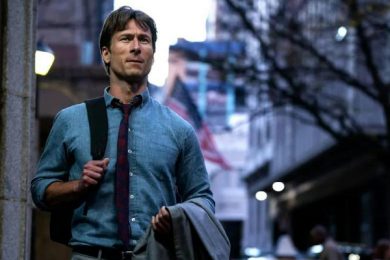
So something like a “biopic” about Anthony Bourdain has the kind of cynical quality of something the chef and writer himself would probably hate. And he probably would, on principle, even though Matt Johnson’s Tony is actually quite good. This is the fifth feature from Johnson, a Canadian filmmaker known by many as half of the team behind Nirvanna the Band the Show. Johnson also directed Nirvanna the Band the Show the Movie which came out earlier this year and may still be, for my money, the best film I’ve seen in 2026. (Please take this with a grain of salt. I have a baby now. I don’t get to the movies much.) His taste for dark comedy still runs through his more straightforward films, like 2023’s Blackberry, which surprised many by taking comedic actors Jay Baruchel and Glenn Howerton and making a genuinely effecting industry drama with them. He’s proven he can take material seriously even while his films may lean toward humor.
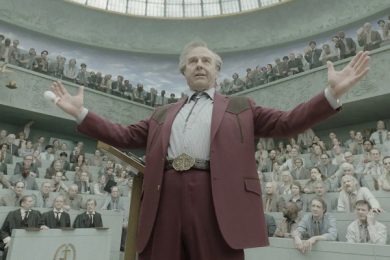
Tony is said to be taken from earlier portions of Kitchen Confidential, though the degree to which the plot is a fictionalized version can be debated. The script was originally written by Todd Bartels and Lou Howe, before being reworked by Johnson and Matthew Miller. The story focuses on a single Summer before Bourdain decides to become a chef. Dominic Sessa, previously the star of 2023’s The Holdovers, plays Anthony “Tony” Bourdain as a nineteen-year-old college student at Vassar. The film opens with Tony before a three-man committee trying to get a writing fellowship. Tony’s goal is to become a writer, though he sees the fellowship as an opportunity to fund a Summer in New York City, with little plans to actually write. So overconfident is he that he’s getting the fellowship that, when he ultimately is rejected, he decides it’s easier to tell everyone that he got it. This includes a former high school crush, Nancy (Emilia Jones). When he hears Nancy is spending her own Summer in Provincetown, and having no actual plans of his own, Tony jumps on a bus up to Massachusetts with no plan other than hoping to win her over.
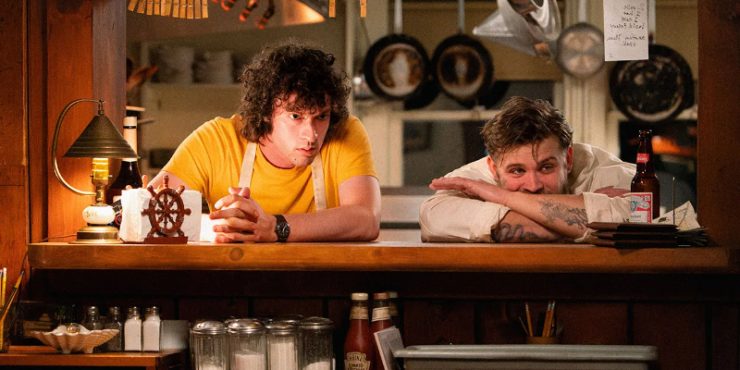
This plan backfires, and he ends up drunk at a local restaurant, The Flagship, pestering the wait staff while unable to pay for his beers. The restaurant’s chef (Antonio Banderas) kicks him out, but ultimately lets Tony sleep in a hammock on his porch when he finds him later than night passed out in the street. Still unable to pay for a place to sleep or a ferry ticket home, the Chef (as he’s called), decides to let Tony work as a dishwasher at The Flagship in exchange for room and board. In the small kitchen, Chef works with quiet intensity while the rest of the kitchen staff chugs away with abandon. There’s the soft-spoken Tyrone (Michael Jibrin), the slovenly lobster cook Stavros (Stavros Halkias), and then there’s Sal (Leo Woodall), an oyster shucker whose volatility and womanizing is constantly putting him at odds with polite society. Sal’s seductive charm and fearless energy is appealing to the young Tony, even as Sal shows major signs of instability. It’s no surprise when we learn that Sal’s lifestyle is fueled by major drug use.
Tony’s main motivation remains the courting of Nancy, but he finds himself more and more drawn into the world of The Flagship, allowing him to lean into the rebellion of his upper-middle class upbringing. This includes his supportive but overbearing father (Rich Sommer) and his domineering, hard-to-please mother (Dagmara Dominczyk). In The Flagship, he finds himself pulled between the studied seriousness of Chef and the alluring unpredictability of Sal. When Tony finally gets the opportunity to cook, he surprises everyone with his prowess. His creativity strikes Chef, whose own culinary imagination had been dormant for a long time. Chef allows Tony to explore his abilities, even though Tony still shows little interest in cooking as a profession. Tony presents this Summer as a fork-in-the-road moment in the life of a young man: pursue a vocation that requires hard work and dedication, or give in to his demons of self-destruction.
Tony does a really good job evoking a time and place, if not as good of a job evoking the person Bourdain really was. And let’s be clear, creating an authentic nineteen-year-old Bourdain is impossible, and Johnson intelligently steers clear of making a younger version of the whip smart man we came to love as an adult. Coyly, Tony often describes the book he’s not writing as a bildungsroman (a coming-of-age story), a nod to what Johnson and Miller are trying to create in their version of the script. There’s anonymity to the Tony we see in this movie – he could be any mildly talented young cook. Johnson is trying to show us how easily the tenuous paths toward success could just as easily crash downward into failure. And a lot of what happens to Tony in this movie could be described as failure, but Tony the film is creating the cauldron that could turn someone as uncouth as Tony into someone as erudite and audacious as Anthony Bourdain.
In fact, the film’s weakest moments come in its attempts to more directly tie the young Tony to Anthony Bourdain. Glimpses of hard drug use and self-harm allude to the famous chef’s demons which (one could argue) led to his ultimate death. Those sequences suggest a certain fated-ness to Bourdain that both doesn’t fit the more easy-going tone of the movie nor the recalcitrant audacity that possessed Bourdain himself. You understand watching Tony that the very hook of the film is that this unlikeable young man will eventually become a beloved figure. The trick that Johnson pulls off is making you recognize that there’s an everyday fallibility even in our most esteemed public figures. This doesn’t quite reach the astute execution of Blackberry and it doesn’t come anywhere near the metaphysical majesty of Nirvanna the Band the Show the Movie, but Tony is further proof that Johnson is a skilled filmmaker who can still find quirk even in a more straightforward film.
.
Directed by Matt Johnson