









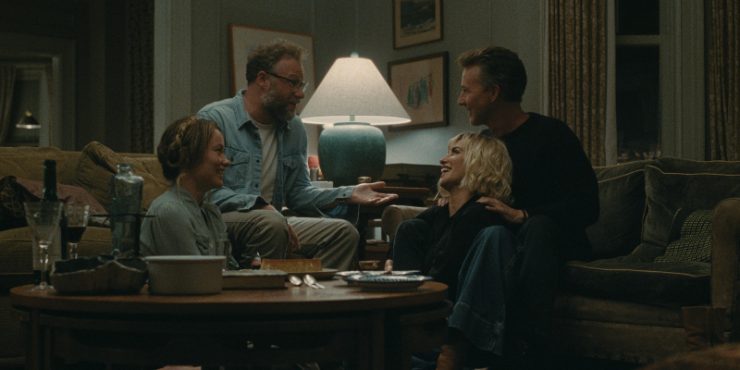
Happy marriages are all alike; unhappy marriages are all unhappy in their own way. Such is the state of the couples in The Invite, the latest film from actress-turned-filmmaker Olivia Wilde. Wilde stars as Angela, a majorly high-strung and minorly hostile stay-at-home mom. Angela’s husband is Joe (Seth Rogen), a majorly hostile and minorly high-strung music teacher. They have a daughter in middle school, whom they both love, but whose presence eases none of the tension between them. What’s gone wrong? Everything in their life seems to trace back to this question, and the husband and wife float through their days dreading that evening’s next argument. In an attempt to create even the slightest illusion of spontaneity in their lives, Angela decides to invite their upstairs neighbors over for dinner. When Joe arrives at home, back spasming, he learns for the first time that they’re entertaining. Worse yet, they’re entertaining Hawk (Edward Norton) and Pina (Penelope Cruz), the upstairs neighbors whose obnoxious sex noises keep them up at all hours.
It’s hard to watch The Invite and not think of Edward Albee’s play Who’s Afraid of Virginia Woolf?, the seismic piece that has set the standard for the one night, two couples story template. But The Invite – which is written by Rashida Jones and Will McCormack – flips the narrative a bit. Angela and Joe are troubled like Martha and George, but they’re not coherent enough to lure the visiting couple into their psychological warfare. No, instead, Angela and Joe end up seduced by the alluring Hawk and Pina, whose very presence exudes the kind of sexual frankness that is the complete antithesis of their romantic lives. This is a film about the power and the consequence of romantic projection, how we observe each other, how we present our love to others, and how you never really know the true nature of any marriage except for the one that you’re in. And even then, you may not be the most reliable source.
The film is based on the 2020 Spanish film The People Upstairs, and is the fifth (and counting!!!) international remake of that film since then. How one film can spark so many versions in such a short amount of time speaks to the potency of its premise. Mixing the ignitable repression of Angela and Joe with the immersive sensuality of Hawk and Pina seems like a combination ripe with comedic possibility. Before we meet these illusive upstairs neighbors, Wilde spends a good chunk tightening the springs on Angela and Joe. They fight over food, over wine, over every detail of the forthcoming night, and especially about the fact that it’s happening at all. Joe hates these neighbors, but Angela seems desperate for something, anything, to break the monotony of her aimless life. Joe can sense that there’s an underlying motive to Angela inviting them over. He comprehends that Hawk and Pina’s boorish sex life is something Angela wants to be close to. But in what way?
The guests show up as they’re in a full-blown fight, and Hawk is quick to mention that they could hear the argument on the other side of the door. This will occur often, Hawk refusing to assuage an awkward moment. Things start rocky, as Angela learns that all of the food she made goes against Pina’s dietary restrictions and, what’s worse, there’s no wine to be had. Joe chooses to be frank with his guests, making his displeasure about the whole night obvious. Hawk chooses to admire Joe for his honesty, a move that only makes Joe that much more spiteful. The hosts’ continued insecurities and eccentricities keep finding their ways into the conversation, but the guests continue to will the night along. When eventually the conversation turns to Hawk and Pina’s loud, disruptive sex, the couples begin to reveal themselves and their more carnal natures.
**SPOILERS** beware. In their utmost wisdom, A24 chose to market this film as a swingers comedy, a choice that might disappoint audiences expecting something more titillating. The truth is that it’s pretty obvious that The Invite is not going to be a film about spouse-swapping, and part of the intrigue comes from how it all will go awry. Hawk and Pina reveal themselves to be practitioners of group sex in their apartment, which is why their sex is always so noisy. They then extend their own invite to Angela and Joe, to become part of their group sessions. They could even, should the hosts be interested, try having group sex tonight. Angela and Joe are flattered, eager even, but when their own antipathy for one another threatens to undo the first exciting thing to happen to them in years, the couples are forced to confront the realities of their relationships.
This is Olivia Wilde’s third film as a director, and the first since Don’t Worry Darling, a pretty high-profile disaster which led to unflattering press for Wilde personally and professionally. The Invite is an appropriately small film, and she nails the most important part which is getting the cast right. The film is ostensibly limited to the four characters previously mentioned, which puts high stakes on who will play them. Rogen is long past the dirtbag years of his Apatow films, but he still has the approachability of an American comedy actor, regardless of the prestige roles he’s gotten to play in the last ten years. Wilde downplays the Hollywood glamor she’s usually known for, and Rogen helps make that more believable. Both Wilde and Rogen lean heavily into the neurosis and the emotional instability. Where we might expect Hawk and Pina to be the eccentrics who reshape the humdrum lives of Angela and Joe, almost the opposite is true: their hostility reveals some holes in the otherwise utopian relationship of the upstairs neighbors.
Which leads me to Penelope Cruz and Edward Norton, two actors with appropriately esteemed reputations, tapping into their most seductive qualities. To say that Cruz and Norton are much better actors than Wilde and Rogen is not an insult, just a plain fact, but it speaks to their skill that they never even attempt to walk off with the movie, instead providing The Invite with the perfect balance of awkward humor, sexual tension, and surprising insight. Norton is an actor known for on-set combustibility, and his “comeback” of sorts in the last decade has been mostly through roles that take aim at that notoriety. But first in 2024’s A Complete Unknown, and now in this film, he’s once again pulling from his very versatile bag of tricks which allowed him to be one of the more exciting actors of his generation. Cruz, an actress who has always embraced her sexiness without ever letting it negate her talent, is the perfect choice for Pina, a woman whose inherent warmth and familiarity allows you to fall under her spell, in where she’ll display a heavier does of authority than you might expect.
The will-they-won’t-they nature of these two couples’ possible dalliance ends up being much less crucial to the structure of the film’s plot. Instead, the film’s script ends up taking a melancholy path, and the conversations steer away from sex, and toward the ways in which love evolves and, in some instances, fades. How do you know someone is the one? More crucially, how do you know when someone no longer fulfills you in your life? Jones and McCormick’s script very ambitiously tries to tackle these questions, and Wilde is ready to lay her characters bare to get there. In the end, Wilde and Rogen being more limited performers makes their resolution only slightly less effective, and a final sequence requires feeling of poignance for these characters that I don’t think the movie ever really achieves. But this is still a very engaging, entertaining film about the trials and tribulations of spending your life with another person. One of the great lines in recent movies comes from Sandra Hüller in Anatomy of a Fall when she explains “a couple is kind of like a chaos”. The Invite speaks to that ethos very well.
.
Directed by Olivia Wilde